


Artificial Intelligence (AI) Technology
Find suppliers of AI solutions for all types of unmanned vehicles (UAV, UGV, USV, UUV), including embedded AI hardware and deep learning software.
Category Presented by

Suppliers
Add your company


Advanced Navigation
High-Accuracy Navigation & Positioning Solutions for Unmanned & Autonomous Vehicles

Platinum Partner

Beyond Vision
Fully Autonomous Multirotor Drones & Hybrid VTOL UAVs With AI Capabilities

Platinum Partner

Wolf Advanced Technology
Rugged Computing and Video I/O Modules: 6U & 3U VPX, XMC, VNX+, and other Small Form Factors and Custom Solutions

Platinum Partner


Exail
Inertial Navigation & Positioning Technology for Unmanned, Autonomous Systems

Platinum Partner

Maris-Tech
Edge AI Video Processing & Streaming Solutions Providing Real-Time Situational Awareness for Mission-Critical UAVs & Unmanned Systems

Gold Partner

Wingman360 AI by Lavionic
Cutting-Edge AI-Powered Digital Assistant for Drone Industry Professionals: UAS Regulations, Compliance & Technical Documentation

Gold Partner
Areté
Cutting-Edge Unmanned Systems-based Sensing Solutions & Counter-UAS Systems for Military & Defense Forces

Gold Partner

Tocaro Blue
Smart Marine Radar Processing Solutions: Advanced Perception & Situational Awareness for Uncrewed & Autonomous Vessels

Gold Partner

Neousys Technology
Industrial-Grade Embedded Computer Systems for AI Edge Computing & Machine Learning

Gold Partner

Overwatch Imaging
Advanced Imaging & Sensor Autonomy for Time-Critical Airborne Intelligence Missions

Silver Partner

Review Display Systems
High-Performance Rugged Displays & Custom HMI Solutions for Mission-Critical Unmanned Systems

Silver Partner

Sense Aeronautics
Cutting-Edge AI-powered Drone Video Analytics Solutions for Object Detection

Silver Partner

Vizgard
Edge-Based Visual AI Software Platform for Defence & Security Camera Automation

Silver Partner

Tilak.io
Embedded Systems Software Development, Firmware Programming & Drone Software Design/Testing Services

Silver Partner

Wavefront Systems
Underwater Sonar: Side-Scan Imaging Sonar & Forward Looking Sonar for Obstacle Avoidance & Navigation

Silver Partner

EIZO Rugged Solutions
High-Performance Video Graphics, GPGPU, AI/ML Processing & Display Solutions for C5ISR Applications

Silver Partner
Showcase your capabilities
If you design, build or supply Artificial Intelligence (AI) Technology, create a profile to showcase your capabilities on this page
Products


Artificial Intelligence (AI) Technology

Drone Machine Learning
Artificial intelligence (AI) is the ability of machines and robots to perform tasks that would normally require human intelligence, which includes an ability to learn and adapt to changing environments.

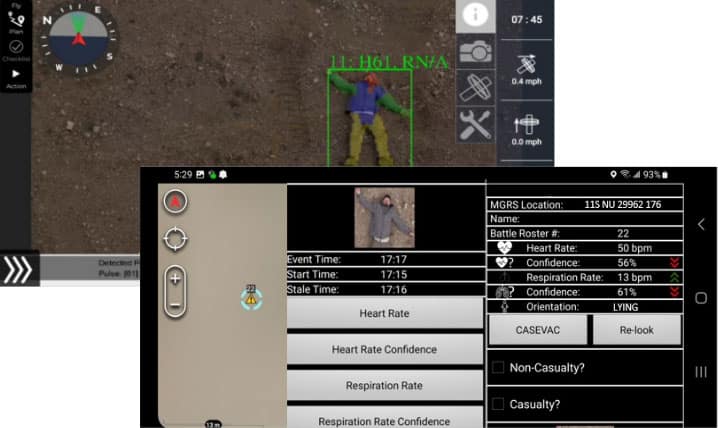
ALLSEEN AI-powered automatic target recognition software by Areté
Machine learning is much more complex to develop, compared to rote learning which can be easily implemented on a computer with lists of rules and is comparatively limited and inflexible.
Successful implementation of AI on drones and unmanned vehicles allows the development of self-piloting systems, thus doing away with the need for human operators. This saves manpower and expenses as well as being more efficient for certain tasks that humans cannot perform as quickly as a computer. It may also be one of the keys to unlocking commercial BVLOS (beyond visual line of flight) drone operations at scale.
Applications
UAVs (unmanned aerial vehicles), UGVs (unmanned ground vehicles) and other robotic platforms may use AI for a variety of applications, including;
- Obstacle avoidance
- Swarm operations
- Real-time data analysis and image classification
- Autonomous precision navigation and landing.
AI empowers a drone or robot to make decisions based on inputs from its sensors, and may also allow the vehicle to continue with its mission even when it loses communications with its base of operations.
Artificial Intelligence Components
Key components of AI are machine learning and deep learning software, which allow computers to employ more sophisticated algorithms such as neural networks in order to find patterns and relationships in data. Neural networks need to be trained by providing them with large amounts of example data to learn from. An example of UAV machine learning would be the use of computer vision and sensors to perform the detection, classification and tracking of potential targets.
Embedded AI

Condor NVP2102AxX with GPGPU computing, AI processing, deep learning capabilities by EIZO
AI for drones and robotics can be performed in the cloud or on edge devices, which in the case of unmanned vehicles means onboard computing. Since the data processing occurs close to the source of the data – the onboard sensors – edge devices can allow results to be obtained faster. Hardware options for drone AI edge devices include general-purpose graphics processing units (GPGPUs), central processing units (CPUs), application-specific integrated circuits (ASICs), and systems-on-a-chip (SoCs).
Onboard AI requires a large amount of processing power, which may make edge devices unsuitable for SWaP (size, weight and power)-constrained vehicles. Taking advantage of the cloud for AI processing, however, requires low latency and high bandwidth, which can be difficult to obtain in remote areas and other subpar communications environments. The transmission of data over long distances also poses security and privacy risks.


