


Suppliers
Add your company
Austars Model
Advanced VTOL & Fixed-Wing UAVs | State-Of-The-Art Technologies for Unmanned & Autonomous Aircraft

Platinum Partner

Trakka Systems
Multi-Sensor Imaging Gimbals, Searchlights and VMS Software for Air, Land & Maritime Platforms

Platinum Partner

Trillium Engineering
UAV Gimbal Payloads - EO & EO/IR Drone Camera Gimbals for Tactical UAS

Platinum Partner
UXV Technologies
Pioneering Ground Control Stations (GCS), Gimbals & Tactical Solutions for Unmanned Systems & Defense Robotics

Platinum Partner

Cubert
Cutting-Edge Hyperspectral Camera Solutions - Critical Real-Time Insights for UAV-Based Applications

Gold Partner

New Imaging Technologies
SWIR Cameras & Sensors for Infrared Imaging Applications With Drones & Unmanned Systems

Gold Partner

Noxant
High-Performance Infrared Cameras & Cores for Surveillance & Monitoring with Drones & Robotics

Gold Partner

SubC Imaging
Cutting-Edge Underwater Imaging Systems & Remote Operations Solutions For Subsea Inspection

Gold Partner

Velox by Nanomotion
Miniature Two-Axis Gyro-Stabilized EO/IR Payloads for Commercial & Defense Applications

Gold Partner

Edge Autonomy
Long-Endurance Fixed-Wing & Hybrid VTOL UAVs | UAV Payload Camera Systems | Power Systems

Gold Partner

Sierra-Olympia Technologies
Infrared (IR) Thermal Imaging Camera Modules for Drones, UAV & Robotics

Gold Partner

MKS-Ophir
High Performance Infrared Zoom Lenses for UAVs and Drones: Low-SWaP, Extended-Range, Ruggedized Lenses

Gold Partner


Overwatch Imaging
Advanced Imaging & Sensor Autonomy for Time-Critical Airborne Intelligence Missions

Silver Partner

Aerora Technology
Innovative NDAA-Compliant Drone Hardware Solutions & Engineering Services

Silver Partner

Steatite
Ultra-Reliable Rugged Hardware Solutions for Mission-Critical UAVs & Unmanned Systems Operating in Extreme Environments

Silver Partner

CHC Navigation
GNSS Positioning & Navigation Systems, Mobile Mapping UAV LiDAR & Unmanned Surface Vehicles

Silver Partner


Showcase your capabilities
If you design, build or supply UAV/Drone Cameras, create a profile to showcase your capabilities on this page
Products


UAV/Drone Cameras for Commercial, Industrial, and Military Applications

Drone cameras are a powerful blend of innovation, versatility, and functionality. They serve as the eyes of UAV systems. Equipped with high-resolution imaging sensors and tailored technologies, they capture detailed visuals across the electromagnetic spectrum.
Key UAV Camera Technologies

HD45 Drone Camera by Trillium Engineering
Each camera technology offers unique capabilities tailored to specific applications. Below are the main types of drone camera technologies and their features:
RGB Cameras (color – visible spectrum)
RGB (red, green, blue) cameras provide vibrant color imaging and are the most common type of drone cameras. They are ideal for aerial photography, videography, real estate marketing, and infrastructure inspection. With high megapixel resolutions and adjustable focal lengths, these cameras capture detailed images for commercial and industrial use.
Thermal Imaging Cameras
Thermal cameras detect infrared radiation emitted as heat, enabling visibility in complete darkness or through smoke, fog, and other obscurants. These are critical in:
- Military surveillance for identifying hidden threats.
- Industrial inspections to detect overheating components.
- Disaster response and search-and-rescue missions.
MWIR Cameras (Medium-Wave Infrared)

Multiple application payload camera by Edge Autonomy.
MWIR cameras excel at detecting temperature variations in mid-range wavelengths. Commonly used in:
- Military and tactical drones for long-range surveillance.
- Pipeline inspections to identify leaks or structural vulnerabilities.
- Environmental monitoring, including wildfire detection.
SWIR Cameras (Short-Wave Infrared)
SWIR technology enables imaging through smoke, haze, and even certain fabrics. These cameras are widely utilized in:
- Maritime surveillance for enhanced visibility at sea.
- Industrial applications like oil spill detection.
Military-grade drones for covert operations and target identification.
Hyperspectral Cameras

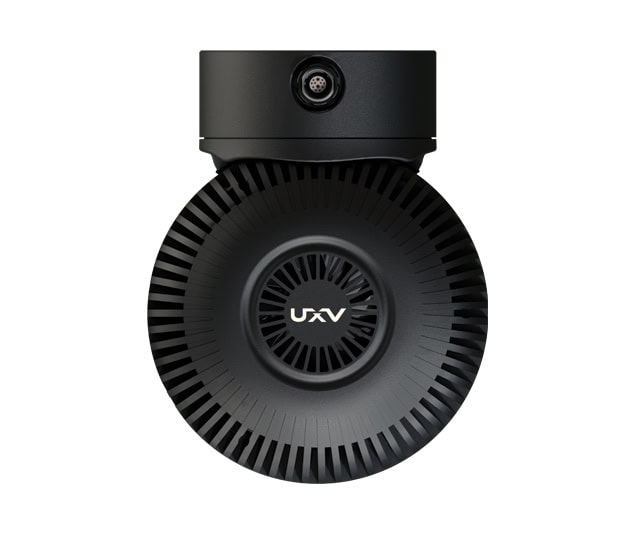
Optroxa GMB-450 UAV Camera by UXV Technologies
Hyperspectral cameras analyze a wide spectrum of light, providing data beyond visible wavelengths. Applications include:
- Precision agriculture for crop health monitoring.
- Mineral exploration in mining operations.
- Environmental research for habitat conservation and pollution detection.
Multispectral Cameras
Multispectral cameras focus on specific wavelengths, often capturing 4-10 spectral bands. They are indispensable in:
- Forestry management to track deforestation.
- Archaeological surveys to uncover historical sites.
- Urban planning for green space analysis.
Night Vision Cameras
Designed for low-light environments, night vision cameras rely on near-infrared (NIR) technology to amplify available light. They are widely used in:
- Tactical military drones for nighttime reconnaissance.
- Border security operations for detecting unauthorized movement.
- Law enforcement applications, including search missions.
Ultraviolet (UV) Cameras

Lightweight EO/IR aerial imaging system from Trakka Systems.
Ultraviolet cameras capture ultraviolet light, which is invisible to the human eye. These are particularly effective in:
- Detecting corrosion and structural weaknesses in industrial assets.
- Forensic investigations and material analysis.
- Pollution detection and monitoring.
Stereoscopic Cameras
Stereoscopic cameras capture 3D imagery by combining data from two lenses. This technology is used in:
- Cinematic production for immersive visual effects.
- Infrastructure inspection for precise depth measurements.
- Geological surveys and 3D modeling.
Industry-Specific Applications
Commercial Applications
Drone cameras are transforming industries by delivering high-quality data for decision-making and planning.
- Construction: Regular aerial inspections with RGB or thermal cameras help track progress and identify potential safety risks.
- Real Estate: Drones equipped with 360-degree or RGB cameras create dynamic marketing visuals that attract buyers.
- Precision Agriculture: Multispectral and hyperspectral cameras provide farmers with detailed insights into crop health and soil conditions.
Industrial Applications

Thermal imaging payload with laser rangefinder from Gremsy.
Industrial operations rely on drone cameras to improve safety and efficiency.
- Infrastructure Inspection: Cameras like thermal imaging systems detect structural flaws in bridges, powerlines, and pipelines.
- Energy Sector: UAVs with SWIR and thermal sensors monitor oil rigs, refineries, and solar farms for defects.
- Mining and Surveying: Multispectral and stereoscopic cameras create detailed maps of terrain, aiding in resource extraction and land management.
Military Applications
In military and tactical operations, drone cameras deliver critical intelligence.
- Reconnaissance: SWIR and MWIR cameras provide clear imaging under harsh environmental conditions, while night vision enhances low-light operations.
- Surveillance: Advanced gimbal-stabilized systems track targets with precision.
- Search and Rescue: Thermal cameras identify heat signatures in disaster zones, even when visibility is limited.
Emerging Trends in Drone Camera Technologies
Innovative advancements are transforming the capabilities of drone cameras, enabling them to meet increasingly complex demands. One significant development is the integration of artificial intelligence, where machine learning algorithms empower cameras to detect, classify, and track objects automatically. This automation enhances operational efficiency and accuracy in various applications.
Another breakthrough is the use of polarimetric imaging technology. Cameras equipped with polarimetric sensors can capture detailed information about light polarization, which is particularly valuable for identifying materials such as oil slicks on water or icy surfaces. This capability expands the scope of drones in environmental monitoring and disaster response.
Compact multisensor payloads are also redefining versatility in drone imaging. By combining shortwave infrared (SWIR), mid-wave infrared (MWIR), and hyperspectral imaging technologies into a single payload, drones can perform diverse tasks without changing equipment. This integration streamlines operations and maximizes the efficiency of aerial missions.

SWIR camera from MKS | Ophir.
Finally, advancements in data transmission are ensuring faster and more reliable communication. Enhanced wireless systems now enable real-time streaming of high-resolution video, providing operators with immediate access to critical information. This rapid data delivery supports timely decision-making in scenarios where every second counts.
How to Select the Right Drone Camera
Choosing the perfect camera for a drone depends on the mission’s objectives.
- Military Use: Tactical operations require thermal, SWIR, or night vision cameras for enhanced situational awareness.
- Industrial Inspection: MWIR or thermal imaging systems are ideal for detecting flaws in infrastructure and machinery.
- Commercial Use: RGB and multispectral cameras deliver excellent results for aerial photography and environmental monitoring.
When selecting a camera for specific needs, consider factors such as resolution, weight, compatibility with UAV systems, and weather resistance.
Comprehensive Solutions for UAV Imaging
Drone cameras are at the forefront of innovation, driving progress in industries ranging from agriculture to defense. With advanced technologies such as SWIR, MWIR, and hyperspectral imaging, they provide actionable data in even the most challenging environments. As UAV capabilities continue to grow, the integration of smarter, more versatile imaging systems will redefine the limits of aerial data collection and analysis.
Drone cameras offer unmatched versatility, making them indispensable tools for commercial, industrial, and tactical applications, from environmental monitoring to military-grade surveillance.


