


Suppliers
Add your company
Honeywell Aerospace
BVLOS Solutions for UAS & UAM: Fuel Cells, Radar, Navigation Sensors, Flight Control & SATCOM

Platinum Partner
uAvionix Corporation
Certified UAV Communications, Navigation, Control, Surveillance, and Combat ID Solutions

Gold Partner

Sagetech Avionics
Certifiable Situational Awareness & BVLOS Solutions for Uncrewed Aircraft Systems in the Defense & Civil Industries

Gold Partner

Sense Aeronautics
Cutting-Edge AI-powered Drone Video Analytics Solutions for Object Detection

Silver Partner


Sunhillo Corporation
Radar & ADS-B Surveillance Data Fusion, Integration & Display | UAV Tracking & ATC Integration

Silver Partner


Aerobits
Miniature ADS-B Technology (Transceivers/Receivers) and Drone Tracking Transponders for sUAS & UTM/U-Space

Silver Partner
Showcase your capabilities
If you design, build or supply Detect and Avoid (DAA) Systems, create a profile to showcase your capabilities on this page
Products

Detect and Avoid (DAA) Systems for Unmanned Vehicles

Detect and avoid systems allow unmanned vehicles to autonomously recognize other aircraft, objects, and terrain in their operational environment. Once potential collisions are identified, the system processes available data and triggers avoidance maneuvers to ensure continued safe operation. This capability is essential for enabling UAVs and other platforms to operate safely without direct line-of-sight observation, especially in dense or unpredictable environments. By combining real-time sensing with advanced decision-making algorithms, DAA systems enhance both safety and mission efficiency.
Core Components of DAA Systems
Effective DAA systems are made up of an integrated array of hardware and software, including:
- Sensors: These include radar, LiDAR, EO/IR cameras, ultrasonic detectors, ADS-B transceivers, and acoustic sensors that provide environmental awareness.
- Inertial navigation and positioning systems: Such as INS, IMUs, GNSS, RTK, and magnetometers, help correlate detected objects with the vehicle’s motion and location.
- Computing platforms: Utilize object detection algorithms, sensor fusion, and AI-driven decision-making to assess threats and inform maneuver strategies.
- Communications: ADS-B In/Out, telemetry systems, and datalinks provide situational awareness across vehicles and ground control stations, enhancing overall situational awareness.
Sensor Technologies in DAA Systems

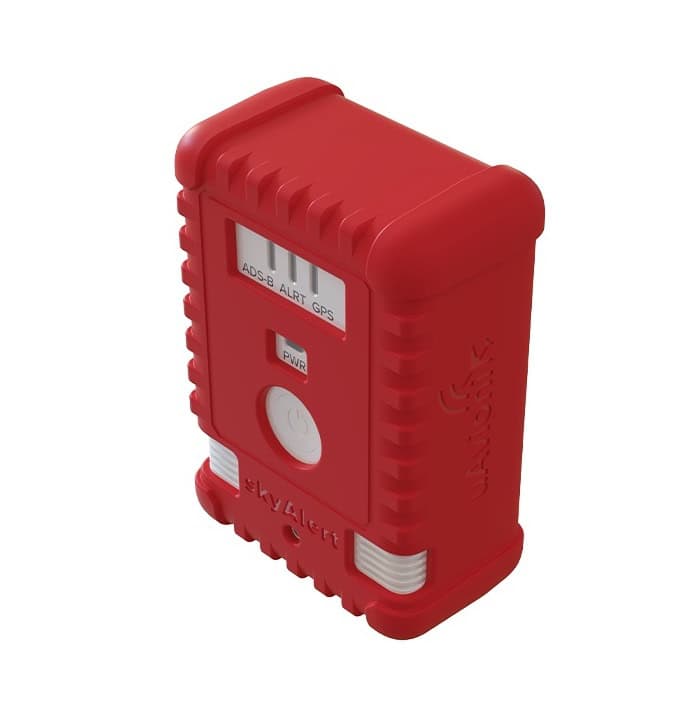
Casia G Detect & Alert System by uAvionix
The performance of a DAA system hinges on the quality and configuration of its sensors. Radar provides long-range detection and operates reliably in most weather conditions, making it suitable for high-speed operations. LiDAR provides detailed 3D mapping of nearby terrain and structures, although its effectiveness can be reduced by fog or precipitation.
EO/IR cameras support vision-based navigation and object recognition, essential for low-altitude or close-range operations. Acoustic and ultrasonic sensors are more commonly used in ground and underwater vehicles for short-range navigation, while advanced sensor fusion techniques combine data from multiple sources to enhance accuracy.
Integration of DAA Systems into Unmanned Platforms
Incorporating DAA systems into unmanned vehicles involves addressing constraints related to size, weight, power consumption, and environmental resilience. Smaller drones require miniaturized sensors and embedded computing platforms that don’t compromise flight time. Ground and marine platforms often require ruggedized systems to withstand harsh conditions, such as vibration, water ingress, or extreme temperatures. Compatibility with existing avionics, autopilot systems, and telemetry networks is essential for seamless operation. As detect and avoid technology matures, modular solutions are emerging that can be adapted across multiple platforms with minimal customization.
Unmanned Aerial Vehicles (UAVs)
In UAV operations, detect-and-avoid systems are crucial for enabling autonomous navigation and collision-free flight, especially during Beyond Visual Line of Sight (BVLOS) missions. For example, delivery drones operating in suburban areas must recognize and avoid buildings, trees, and other aerial vehicles while adhering to airspace regulations. In UAM scenarios, such as air taxis or cargo drones, DAA systems enable safe operations in highly congested urban airspaces where unpredictable obstacles are common. These systems are also essential for missions in remote areas, including agricultural fields and forests, where obstacles may not be mapped or known in advance.
Unmanned Ground Vehicles (UGVs)
UGVs utilize DAA systems to navigate industrial, urban, and off-road environments while avoiding pedestrians, obstacles, and other vehicles. In mining operations, for example, autonomous haulers must navigate shifting terrain and coordinate with other heavy machinery in real time. In defense applications, DAA allows robotic scouts or bomb disposal units to maneuver through urban environments or active combat zones with minimal operator input. These vehicles often use a combination of LiDAR, ultrasonic sensors, and machine vision to detect threats and navigate accordingly.
Unmanned Surface Vehicles (USVs)
DAA systems on USVs help avoid collisions with ships, buoys, and coastal features during missions in crowded or complex waterways. These systems often rely on maritime radar, AIS (Automatic Identification System), and vision-based object detection to maintain situational awareness. USVs may operate autonomously for maritime surveillance, scientific research, or infrastructure inspection, and DAA ensures safe and uninterrupted operation even when communication with control centers is limited. Environmental sensors also help detect floating debris or shallow water, enhancing mission adaptability.
Autonomous Underwater Vehicles (AUVs)
In deep-sea or near-shore operations, AUVs equipped with DAA systems must navigate environments with poor visibility and limited communication. Sonar and acoustic imaging help avoid underwater hazards such as reefs, shipwrecks, and subsea infrastructure. These vehicles are commonly used for seafloor mapping, pipeline inspection, and marine biology research. By integrating real-time obstacle avoidance, AUVs can complete long-duration missions without surface-level supervision or the risk of collision-related failures.
Applications of Detect and Avoid Systems
Urban Air Mobility (UAM)

Detect and Avoid Solutions & Software by Sagetech Avionics
Urban air mobility platforms depend heavily on DAA systems to manage flight safety amid skyscrapers, power lines, and congested air corridors. Air taxis, for example, must maintain real-time awareness of both static obstacles and dynamic threats such as other aircraft and environmental hazards like birds or drones.
By combining ADS-B, radar, and visual sensors, these systems enable coordinated navigation and airspace deconfliction in real-time. UAM systems also rely on detect and avoid to comply with air traffic control protocols and demonstrate safety equivalency to manned aviation.
Delivery and Logistics
Autonomous drones performing delivery missions, whether for retail packages, medical supplies, or emergency equipment, must navigate complex environments at low altitude. Detect and avoid systems enable these drones to dynamically reroute when unexpected obstacles, such as cranes, construction zones, or other UAVs, are encountered. In addition to airspace deconfliction, these systems ensure ground safety by avoiding power lines and tall trees near drop-off points. Integrated DAA is also essential for time-sensitive deliveries, where delays due to safety concerns could compromise the mission.
Search and Rescue (SAR)
Search and rescue drones are frequently deployed in unpredictable and hazardous environments, including mountainous terrain, collapsed buildings, and disaster zones. DAA systems enable these UAVs to safely maneuver through narrow gaps, around debris, and in low-visibility conditions. By incorporating thermal imaging and EO/IR sensors, these systems not only help detect obstacles but also identify people in distress. Real-time navigation and threat avoidance enable SAR teams to focus on rescue rather than navigating challenges, thereby improving both response time and success rates.
Agriculture
In agricultural settings, UAVs operate close to the ground and near structures such as silos, irrigation equipment, and treelines. Detect and avoid systems prevent mid-air collisions with these features and ensure continuous coverage of target areas, such as crop rows or pastures. Many agricultural drones use computer vision and sensor fusion to detect and respond to moving hazards, such as livestock or farm equipment. This automation enables large-scale data collection and crop spraying without requiring constant human supervision, thereby increasing operational efficiency and safety.
Infrastructure Inspection
Drones inspecting power lines, pipelines, bridges, and telecommunications towers must operate very close to complex structures. DAA systems enable safe autonomous operation even in environments with limited GNSS availability or visual line of sight. These systems use stereo cameras, LiDAR, and proximity sensors to prevent collisions while allowing detailed inspection data to be gathered at close range. For critical infrastructure, where safety and uptime are paramount, DAA-equipped UAVs are transforming how routine inspections are conducted.
Environmental Monitoring and Research
UAVs used in environmental monitoring must often operate in remote, rugged, or GPS-denied environments such as dense forests, coastlines, or polar regions. DAA systems allow these drones to navigate safely despite limited visibility and highly variable terrain. These missions typically include collecting atmospheric samples, tracking wildlife, or mapping environmental changes. Reliable DAA systems ensure that the data collection mission is not interrupted by avoidable collisions, thereby preserving both the equipment and the scientific output.
Regulatory Considerations
Regulatory agencies like the FAA, EASA, and ICAO require or recommend DAA systems for certain classes of UAVs, particularly those flying BVLOS or in controlled airspace. In the U.S., Part 107 Waivers for BVLOS operations often hinge on the use of proven DAA systems that meet performance-based standards. Compliance with documents such as RTCA DO-365 and ASTM F3442 ensures that these systems have undergone rigorous testing for reliability and safety. As unmanned traffic management (UTM) systems evolve, DAA integration will be increasingly critical to ensure unmanned aircraft can share airspace with manned aircraft under coordinated control.
A Defining Step Toward Broader Unmanned Vehicle Adoption
These systems enable vehicles to accomplish complex missions without requiring direct human oversight. As sensor technologies and processing algorithms continue to improve, the reliability, scalability, and efficiency of DAA-equipped platforms will also grow. Their integration represents not only a technical necessity but also a defining step toward the broader adoption of autonomous unmanned systems in the global transportation, defense, and commercial ecosystems.


