


Suppliers
Add your company
Honeywell Aerospace
BVLOS Solutions for UAS & UAM: Fuel Cells, Radar, Navigation Sensors, Flight Control & SATCOM

Platinum Partner

SKYTRAC
UAV, UAS, and UAM Satellite Communications – BVLOS and C2 Satcom Terminals and Mission Servers

Platinum Partner

Maris-Tech
Edge AI Video Processing & Streaming Solutions Providing Real-Time Situational Awareness for Mission-Critical UAVs & Unmanned Systems

Gold Partner

Videosoft Global
Ultra-Low-Bandwidth Real-Time Video Streaming Solutions for UAVs, Unmanned & Robotic Systems

Gold Partner

LiveU
UAS Video Streaming Technology: Secure, Low-Latency, Live Video Streaming and Transmission Solutions

Gold Partner

Apella Solutions
UAV Antennas, Tracking & Video Solutions for Mission-Critical Connectivity, Real-Time Visibility, & Robust Communications

Silver Partner

Chess Dynamics
Electro-Optical Surveillance and Video Processing for Unmanned Systems & Counter-Drone Applications

Silver Partner
Showcase your capabilities
If you design, build or supply Drone Video Streaming, create a profile to showcase your capabilities on this page
Products




Drone Video Streaming Technology

As the demand for live aerial data grows, the capabilities of drone video streaming systems have become increasingly sophisticated.
Modern systems must deliver high-resolution imagery with minimal latency, often under challenging conditions and in remote locations. The relationship between robust hardware and intelligent software ensures that data is not only captured accurately but also transmitted securely and efficiently.
Core Components of UAV Live Video Streaming

Drone video streaming solution, LU300S, from LiveU.
At the heart of any drone video streaming solution are the components responsible for capturing, compressing, and transmitting video in real time. These elements must work seamlessly together to support demanding applications across sectors such as security, defense, construction, and emergency response.
- Cameras: High-definition (HD), thermal, and zoom cameras mounted on stabilized gimbals ensure clear, targeted imaging under all conditions.
- Video encoders: Devices leveraging H.264 and H.265 compression reduce data load while maintaining quality, supporting efficient bandwidth use.
- Transmission units: Portable, compact units combine bonded connectivity using multiple networks (e.g., RF, 4G/5G, satellite) to ensure resilient, high-quality video links.
- Ground control systems: These receive live feeds and often connect to remote command centers or cloud platforms, enabling distributed team access and collaborative decision-making.
Transmission Technologies
Choosing the right transmission technology is critical for achieving reliable and clear video streams. The method used depends heavily on the operational range, data rate requirements, and environmental conditions. Each technology presents its own set of benefits and limitations, and selecting the appropriate one can make the difference in mission success.
RF Datalinks
Wireless datalinks provide robust, low-latency communication over short to medium ranges, often used in tactical or line-of-sight missions.
Cellular Networks
4G LTE and 5G connections enable high-bandwidth video streaming across long distances, ideal for urban and suburban deployments.
Satellite Communication (SATCOM)
SATCOM is crucial for beyond visual line of sight (BVLOS) operations, supporting maritime patrols, border surveillance, and remote monitoring.
Cloud Streaming Platforms
Cloud-based systems support the secure distribution of live UAV footage to multiple users worldwide, with control rooms, analysts, and stakeholders accessing real-time intelligence simultaneously.
Applications Across Industries

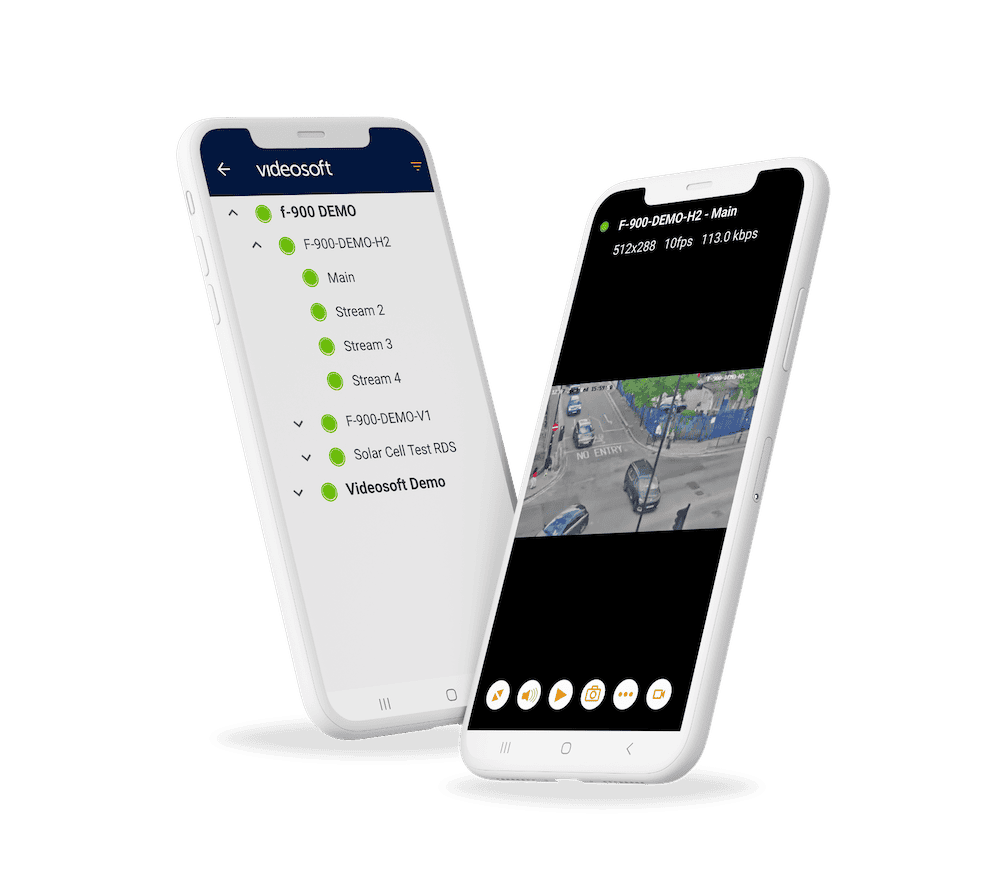
Drone video streaming solution, Firelight, by Videosoft.
The versatility of UAV video streaming has led to its adoption across various commercial, industrial, and defense sectors. These systems provide invaluable support in environments where real-time data is critical for decision-making, operational efficiency, and safety.
Law Enforcement & Public Safety
Unmanned systems equipped with live video streaming enhance situational awareness during public safety operations. Real-time feeds assist in crowd monitoring, traffic management, and tactical responses. Advanced systems also support rapid incident response and coordinated emergency services.
Infrastructure Inspection
Inspection UAVs inspect bridges, pipelines, and power lines, transmitting live footage to engineers for immediate assessment. This approach reduces inspection time and enhances worker safety, particularly in hazardous or hard-to-reach locations.
Environmental Monitoring
UAVs monitor wildlife, track environmental changes, and assess disaster impacts. Live streaming capabilities allow researchers and agencies to observe and respond to events as they unfold, improving environmental oversight.
Construction & Site Management
Real-time aerial views assist in tracking construction progress, ensuring compliance, and facilitating communication among stakeholders. Remote access to live feeds supports centralized project management across large or distributed sites.
Maritime Operations
In maritime patrols, drones provide live feeds of vast ocean areas, aiding in search and rescue missions, illegal activity monitoring, and environmental assessments. Long-range communication links are especially critical in this domain.
Defense & Military Operations
In defense settings, UAV video streaming supports intelligence, surveillance, and reconnaissance (ISR). Real-time video feeds are transmitted securely to command centers, enabling informed decision-making during missions. Cloud-based platforms facilitate simultaneous viewing by multiple units, while portable transmission units ensure reliable communication in contested environments.
Advancements in Streaming Technologies
Continuous innovation in drone video streaming is driving new levels of capability and performance. Emerging technologies are enhancing the reliability, resolution, and intelligence of video transmission systems, enabling UAVs to function more autonomously and deliver more actionable insights.
- Low-latency streaming: Essential for applications requiring immediate decision-making, such as search and rescue operations or combat support.
- Embedded computing: Reduces the need for bandwidth by processing data on board, allowing for local analytics and faster responses.
- AI integration: AI technology automates object detection, behavior analysis, and anomaly alerts, enhancing the utility of drone footage in surveillance and reconnaissance.
- Mesh networks: Improve operational range and resilience by enabling drones and ground units to relay signals across dynamic, ad-hoc networks.
Selecting The Right Drone Streaming Solution
Selecting an appropriate drone video streaming system requires a clear understanding of mission objectives, environmental conditions, and technical constraints. Enterprises and defense agencies must weigh performance against cost, integration capabilities, and long-term scalability to ensure the chosen solution meets current and future needs.
- Operational requirements: Determine the necessary range, resolution, and latency based on specific use cases, from perimeter security to battlefield reconnaissance.
- Environmental conditions: Select robust equipment and communication technologies suited to weather extremes, urban density, or remote terrains.
- Regulatory compliance: Ensure legal alignment with aviation, data protection, and frequency allocation laws in operational regions.
- Integration capabilities: Look for systems that integrate with cloud platforms, mission management software, and multi-source intelligence systems.
The Importance of UAV Video Streaming
UAV video streaming stands at the intersection of advanced imaging, real-time communication, and data analytics. Its applications span numerous industries, offering enhanced efficiency, safety, and insight. From commercial inspection and construction to environmental conservation and battlefield intelligence, streaming drones are redefining how live data is gathered and used. As technology advances, expect these systems to become even more integral to enterprise operations, security planning, and mission-critical deployments.


