


Suppliers
Add your company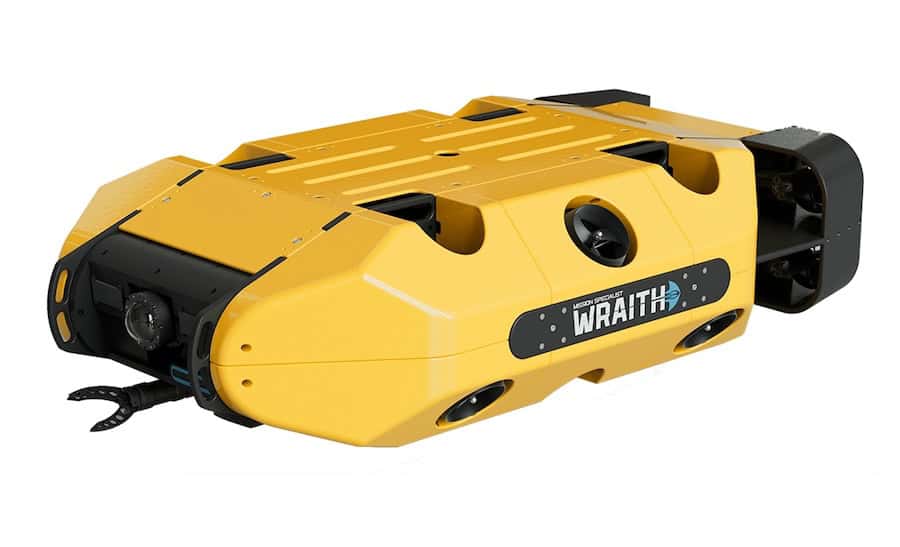
VideoRay
Powerful Underwater Robotics for Commercial, Industrial & Military Applications

Gold Partner


Boxfish Robotics
Cinematic Underwater Robotic Vehicles (ROV & AUV) for Inspections, Observation and Videography

Silver Partner
Showcase your capabilities
If you design, build or supply Inspection ROV (Observation-Class), create a profile to showcase your capabilities on this page
Products



Inspection ROVs: Observation-Class Subsea Systems for Marine & Structural Monitoring

An inspection ROV is a remotely operated underwater vehicle designed primarily for visual and non-destructive inspection tasks. Unlike heavy-duty work-class ROVs, which are built for construction and intervention, inspection ROVs are lighter, more compact, and optimized for surveillance and data acquisition. These systems are typically deployed via tether from a surface vessel or platform and are controlled in real-time by an operator.
The central function of an inspection ROV is to provide live video feeds and environmental data from submerged assets or environments. High-resolution cameras, sonar systems, lighting arrays, and various sensors can be integrated depending on the inspection requirements. Their agility and small footprint make them ideal for confined or complex spaces such as ballast tanks, pipelines, or submerged infrastructure.
Understanding the inspection class

Mission Specialist Pro 5 Inspection ROV by VideoRay
Inspection ROVs can be operated from small boats, docks, or land-based facilities. They are typically optimized for general visual inspection (GVI), close visual inspection (CVI), and environmental monitoring.
Compared to work-class ROVs, observation-class systems lack manipulator arms and high-lift capacities. However, they excel in ease of deployment, cost-efficiency, and minimal support requirements. This makes them particularly suitable for recurring inspections and rapid deployment in emergency or time-sensitive scenarios.
There are also hybrid and mini-ROVs within this class, which offer enhanced portability and can access extremely tight spaces, making them ideal for applications such as water tank inspections, sprinkler tank inspections, or internal confined space inspections.
Inspection-class ROVs are further categorized into two main sub-classes based on their capabilities and onboard systems:
Class I: Observation Only
These are the most basic ROV systems designed purely for visual observation and monitoring. Class I ROVs are equipped with one or more cameras and basic lighting systems, and they are not designed to carry additional tools or sensors. Their primary role is to provide real-time video feeds for general visual inspection (GVI) tasks, particularly in low-risk or easily accessible environments. They are highly portable and often used for training, shallow-water research, and simple site inspection missions.
Class II: Observation with Payload

SRV-8 ROV by Oceanbotics
Class II ROVs offer enhanced functionality by supporting additional payloads such as sonar, environmental sensors, laser scalers, or even limited non-destructive testing (NDT) tools. This added versatility enables them to perform more complex inspections, such as close visual inspections (CVI), structural assessments, or environmental monitoring, in a wider range of conditions. While still compact and lightweight, Class II systems balance capability and deployability, making them suitable for commercial, industrial, and scientific applications that require more than basic observation.
These sub-classifications enable operators to select the most suitable ROV for their mission requirements, balancing cost, complexity, and operational objectives.
Applications of inspection ROVs
Offshore and subsea infrastructure inspection
Observation-class inspection ROVs are widely used for inspecting offshore oil and gas structures, including risers, jackets, and platforms. Equipped with sonar and HD cameras, they perform routine offshore inspections to detect corrosion, assess integrity, and support cathodic protection inspection. These systems enable the safe monitoring of structural health in high-risk, deep-water environments without diver intervention.
Pipeline inspection
Subsea pipelines are prone to damage, biofouling, or misalignment due to marine currents or geological activity. Inspection ROVs equipped with laser scanners, sonar, or pipe-tracking systems can perform pipeline ROV inspections that detect structural anomalies, sediment buildup, or leakage. The vehicles can navigate long stretches while capturing continuous video and sensor data for real-time assessment.
Environmental and habitat monitoring
In marine biology and oceanographic research, inspection ROVs are used for habitat monitoring, environmental surveys, and underwater surveillance. The observation-class ROV’s ability to collect video and water quality metrics without disturbing sensitive ecosystems makes it an essential tool for long-term studies and environmental compliance assessments.
Aquaculture inspections
ROVs are commonly deployed in aquaculture facilities to monitor net pens, inspect fish health, and check for structural integrity of cages and mooring systems. Their rapid deployment capabilities and real-time feedback allow fish farm operators to respond quickly to maintenance needs or environmental changes.
Civil infrastructure and dam inspections

PIVOT Observation-Class ROV by Deep Trekker
Dams, bridges, and water intake systems often require underwater inspections that cannot be performed safely by divers. Inspection ROVs can navigate murky or confined water spaces, providing visual inspections of submerged components. For dam inspections and tunnel assessments, ROVs with sonar imaging are particularly valuable for mapping structures where visibility is limited.
Hull and ship inspection
ROVs are routinely used for underwater ship inspections to assess hull integrity, propeller condition, and biofouling levels. Hull inspection ROVs can be launched from piers or harbors, thereby reducing downtime and eliminating the need for dry docking. These inspections support regulatory compliance and optimize maintenance scheduling.
Confined space and tank inspection
ROVs can access internal structures of water tanks, ballast tanks, and industrial containers. Designed for confined space inspection, these systems mitigate the hazards associated with manned entry, offering a faster and more cost-effective alternative. Advanced models can even navigate complex internal geometries using 3D positioning and sonar navigation.
How inspection ROVs perform their tasks

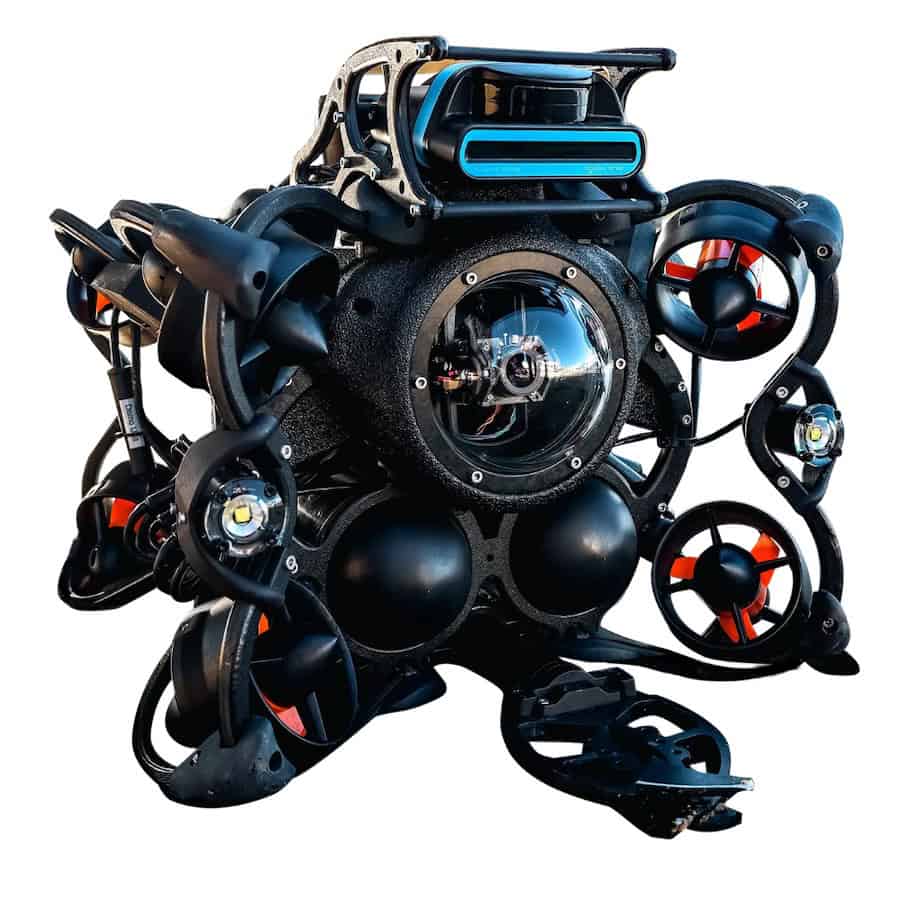
Boxfish Alpha ROV by Boxfish Robotics
An inspection ROV performs its tasks using a suite of integrated tools. High-resolution video cameras protected by tough translucent domes provide operators with real-time situational awareness.
These cameras may be augmented with zoom lenses or 360-degree rotation for close visual inspection (CVI) and general visual inspection (GVI). LED lighting enhances visibility in low-light or turbid water conditions.
Additional sensors may include:
- Sonar systems for imaging in zero-visibility conditions
- Laser scaling tools for precise measurement
- Environmental sensors (temperature, salinity, turbidity)
- Ultrasonic thickness gauges for non-destructive testing (NDT)
Operators control the ROV from a surface control unit, often housed in a portable case or trailer. Tethered systems allow for continuous power supply and high-bandwidth data transmission. For areas with strong currents or depth requirements, ROVs may be fitted with dynamic positioning, auto-heading, and auto-depth features to ensure stability during inspections.
Industries served by inspection ROVs
Inspection ROVs serve a wide array of industries:
- Oil & gas: Subsea asset inspection, rig inspection, pipeline monitoring
- Maritime: Ship hull inspection, harbor survey, port and dock inspection
- Aquaculture: Habitat observation, cage inspection, biomass monitoring
- Civil engineering: Bridge inspections, dams, and tunnel inspections
- Environmental science: Marine surveys, ecological assessment, underwater monitoring
- Energy & nuclear: Reactor inspection ROV applications, infrastructure evaluation
- Shipping & logistics: Vessel inspection, ROV deployments for commercial fleets
As ROV technology advances, new markets such as renewable energy, marine archaeology, and urban infrastructure surveillance adopt observation-class systems.
Key advantages of observation-class ROVs
The use of observation-class inspection ROVs offers several strategic benefits:
- Safety: Eliminates the need for human divers in hazardous conditions
- Efficiency: Reduces inspection time and operational costs
- Versatility: Suitable for both open ocean and confined inland structures
- Data quality: Real-time visual and sensor data support accurate diagnostics
- Mobility: Portable systems deployable from virtually any location
A single ROV system can serve multiple functions across inspection cycles, from initial assessments to routine monitoring and post-maintenance validation.
A blend of mobility, precision, and adaptability makes Inspection ROVs ideal for various subsea applications, from environmental monitoring and underwater surveys to structural inspection and offshore maintenance. As industries emphasize safety, sustainability, and efficiency, the demand for advanced ROV inspection technology is expected to grow, driving innovation in payload integration, autonomy, and remote operation.


