


Suppliers
Add your company
Advanced Navigation
Autonomous Underwater Drone for Subsea Exploration, Survey and Inspection

Platinum Partner
VideoRay
Powerful Underwater Robotics for Commercial, Industrial & Military Applications

Gold Partner


Showcase your capabilities
If you design, build or supply Port Security ROV, create a profile to showcase your capabilities on this page
Products

Port Security ROV

Port security ROV (remotely operated vehicles) provide specialized underwater inspection and surveillance capabilities for harbors, shipping terminals, and maritime approaches. Unlike observation-class ROVs used primarily in offshore energy or scientific research, harbor security ROV systems are tailored to protect critical infrastructure and safeguard national interests. Designed to detect unauthorized divers, inspect hulls and piers for tampering, ROVs can be deployed to prevent sabotage of pipelines, communication cables, and underwater port facilities.
Operating as a standalone system or within a wider security solution for ports and marinas, port safety ROVs strengthen layered maritime defenses by ensuring that submerged areas are no longer blind spots in security operations. These robotic systems combine high-precision imaging, real-time communication, and advanced manipulation to protect vital assets against both criminal activity and asymmetric threats.
Providers of Port Security ROV Solutions
Manufacturers of port safety ROV systems differ significantly from conventional offshore developers. While commercial providers typically emphasize subsea construction, salvage, or scientific survey, harbor security suppliers build platforms specifically for PSUs (port security units) and shipping authorities. Their systems are engineered for rapid deployment from patrol boats, piers, or waterfront checkpoints, eliminating the heavy logistical footprint often required by industrial or work-class ROVs.

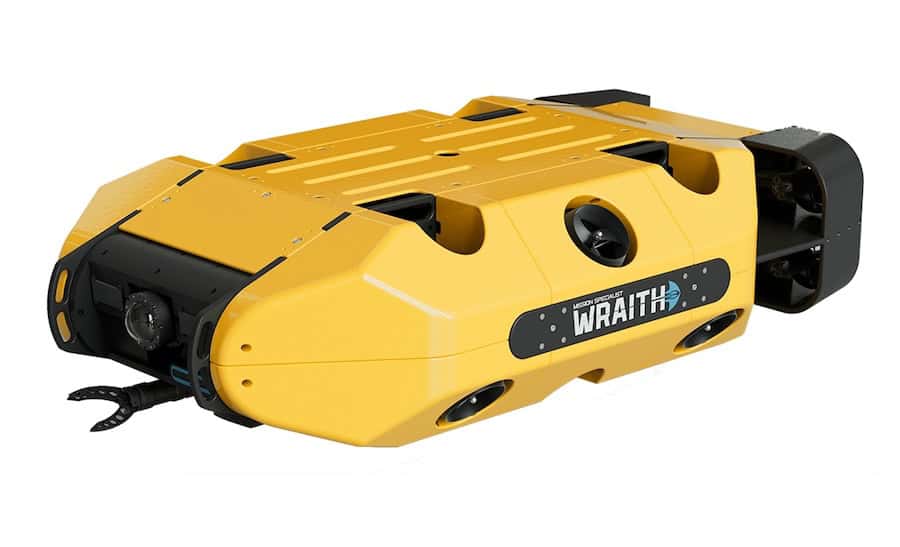
Mission Specialist Defender ROV by VideoRay
Operator interfaces are streamlined so that port security personnel, rather than specialist subsea engineers, can quickly train on and control the vehicles. This human-centered approach ensures that systems can be mobilized immediately in response to developing threats. Port security ROVs additionally feature ruggedized designs that withstand high-current harbor environments, as well as direct integration with encrypted defense communications and centralized port command networks.
Unlike commercial systems that are primarily optimized for maintenance or survey, harbor security ROV systems prioritize rapid detection, classification, and response to underwater threats, making them uniquely suited to the protection of national maritime infrastructure.
Harbor Security ROV Applications
Port safety ROVs address a wide spectrum of underwater security tasks that extend beyond the capability of human divers:
- Underwater inspection of critical assets – Regular monitoring of piers, seawalls, jetties, and fuel pipelines to ensure structural integrity and detect evidence of tampering or sabotage.
- Maritime surveillance in harbor environments – Continuous monitoring of restricted zones, mooring areas, and high-traffic approaches to identify unauthorized underwater activity.
- Mine detection and anomaly surveys – Sonar-equipped ROVs are deployed to detect and classify foreign objects placed on the seabed or attached to structures, mitigating the risk of harbor blockades or explosive sabotage.
- Diver support and counter-intrusion – Equipped with acoustic tracking, ROVs can monitor and follow suspected divers or swimmer delivery vehicles, relaying data back to port security operators for rapid intervention.
- Contraband interdiction – Inspections of vessel hulls, sea chests, and propeller shafts allow harbor security ROVs to identify hidden compartments used for smuggling operations.
Components of Port Safety ROV Systems

Boxfish Alpha ROV by Boxfish Robotics
To function in challenging port conditions, underwater security robots integrate multiple specialized technologies:
- High-definition cameras for visual inspections in turbid or low-light conditions.
- Multibeam and forward-looking sonar arrays that generate clear images of the seabed, divers, and structural anomalies in environments where visibility is poor.
- Manipulator arms and tooling interfaces to enable interaction with below-surface objects, removal of marine growth, or attachment of markers.
- Underwater thrusters and hydrodynamic frames designed for maneuverability in strong currents, vessel wakes, and confined harbor spaces.
- Tether systems and fiber-optic links for secure, low-latency transmission of video and sonar data back to command centers.
Associated Maritime Security Systems & Equipment
Port security ROVs are normally integrated into larger maritime defense and surveillance frameworks. Their live video and sonar feeds are directed into command centers where operators monitor multiple inputs, often alongside radar, diver detection sonar, and vessel tracking data. Patrol vessels and USVs (unmanned surface vehicles) frequently act as deployment platforms, extending the operational range of the ROVs and allowing them to operate in areas that are difficult to access from shore.
These systems may also incorporate non-lethal deterrent capabilities, such as acoustic projectors or strobe emitters, providing an immediate response to diver intrusions until surface teams can act. Additionally, port safety ROVs often operate in coordination with AUVs (autonomous underwater vehicles), which carry out broad patrol missions across wider maritime areas while ROVs focus on precision inspection and intervention. By connecting these assets through secure communication links, port authorities achieve a layered underwater security posture that ensures comprehensive coverage of critical maritime infrastructure.


