


Suppliers
Add your company
HP Additive Manufacturing Solutions
Industrial 3D Printing Solutions for UAV Components, Production, Prototyping & Scalable Drone Manufacturing

Platinum Partner

RIBE
European Engineering, Manufacturing & Drone-in-a-Box Infrastructure Partner for Professional UAV Operations

Silver Partner


Offshore Electronics
Contract Electronics Manufacturing (CEM Services) for Unmanned Systems, UAVs & Robotics

Silver Partner


CRP Group
3D Printing for Aerospace & UAVs: Flight-Ready Parts with CRP Technology's Windform® Composites

Silver Partner
San Francisco Circuits
PCB Fabrication & Assembly; RF, Military Grade, Flex, & Metal Core PCB Capabilities for Unmanned Systems

Silver Partner
Showcase your capabilities
If you design, build or supply Rapid Prototyping, create a profile to showcase your capabilities on this page
Products


Rapid Prototyping for Drones & Unmanned Systems

Developing drones and other unmanned systems requires a fast, efficient approach to design and testing. Rapid prototyping makes this possible by allowing engineers to quickly create and refine physical models before committing to full-scale production. Unlike traditional manufacturing methods, which can be time-consuming and expensive, rapid prototyping enables faster iteration, functional testing, and concept validation.
By integrating advanced techniques such as 3D printing and additive manufacturing, engineers can explore multiple design possibilities, test components in real-world conditions, and optimize performance—all while reducing development time and costs. Rapid prototyping is one of a number of third-party engineering services available to manufacturers of unmanned systems.
Applications of Rapid Prototyping in Drone Development
Rapid prototyping is widely used in drone prototyping and unmanned system development to speed up design cycles and improve final performance. Key applications include:

Drone Rapid Prototype by CRP Technology
- Aerospace Prototyping – Testing lightweight airframes, wings, and support structures to optimize aerodynamics and efficiency.
- Custom Components – Creating 3D printed drone components tailored to specific mission requirements.
- Prototype Testing – Evaluating mechanical properties, heat resistance, and structural integrity before finalizing a design.
- Rapid Prototyping Methods – Using hybrid manufacturing, direct metal laser sintering, and CNC machining to create complex geometries for drones and UAVs.
- Engineering Validation – Ensuring drones and unmanned systems meet safety and performance standards before production begins.
Through rapid prototyping techniques, manufacturers can refine drone designs in a fraction of the time required by traditional fabrication processes.
Key Technologies in Rapid Prototyping
Rapid prototyping for drones and unmanned systems relies on a variety of advanced manufacturing techniques, each offering unique benefits for different applications. While 3D printing and additive manufacturing are central to the process, multiple technologies enable the creation of precise, functional prototypes. Here are some of the most widely used methods:
Fused Deposition Modeling (FDM)
Best for: Low-cost, quick prototypes for structural testing
FDM is one of the most common 3D printing technologies used in rapid prototyping. It works by extruding thermoplastic filament layer by layer to build a solid model. FDM is widely used for creating drone airframes, housings, and lightweight structural components due to its affordability and ability to produce strong, durable parts. However, its resolution and surface finish may not be as refined as other methods.
Stereolithography (SLA)
Best for: High-detail prototypes with smooth surface finishes
SLA uses a UV laser to cure liquid resin layer by layer, creating highly detailed prototypes with fine features. This technology is ideal for producing aerodynamic drone components, intricate payload housings, and internal parts that require precision. SLA parts can also be post-processed for improved mechanical properties, making them useful for both design validation and functional testing.
Selective Laser Sintering (SLS)
Best for: Complex, durable parts without support structures
SLS utilizes a high-powered laser to fuse powdered materials (such as nylon or composite polymers) into solid objects. Because SLS does not require support structures, it allows for more complex drone designs, including internal channels for wiring or aerodynamically optimized shapes. This method is particularly useful for producing lightweight but robust airframe components.
Direct Metal Laser Sintering (DMLS)
Best for: Metal components requiring strength and durability
DMLS is an additive manufacturing process that sinters metal powder using a laser, creating fully functional metal parts. This technology is used for producing aerospace-grade drone components, such as custom brackets, heat sinks, and lightweight structural elements that require high strength and thermal resistance. DMLS allows for the creation of complex geometries that would be difficult to achieve with traditional machining.
Hybrid Manufacturing
Best for: Combining additive and subtractive processes for high precision
Hybrid manufacturing integrates 3D printing with CNC machining or other subtractive methods to produce highly precise, finished parts. This approach is particularly beneficial for UAVs that require both the design flexibility of additive manufacturing and the precision of traditional machining. Components such as UAV motor mounts, propulsion system parts, and aerodynamic surfaces can benefit from hybrid methods.
By leveraging these advanced rapid prototyping technologies, drone engineers can create, test, and refine components faster and more efficiently than ever before. Choosing the right method depends on factors such as material requirements, production speed, and the intended function of the prototype.
Rapid Prototyping vs. 3D Printing

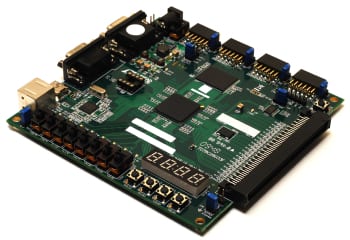
PCB Prototyping by San Francisco Circuits
While 3D printing and additive manufacturing are essential tools in rapid prototyping, they are not the same thing.
Rapid prototyping refers to the overall process of quickly creating and refining prototypes, using various prototyping methods such as CNC machining, hybrid manufacturing, and rapid tooling. The goal is to test and validate designs before committing to large-scale production.
3D printing (additive manufacturing) is a specific digital fabrication technique that builds prototypes layer by layer. It is often used as part of rapid prototyping but is not the only method available.
In other words, 3D printing is a key part of rapid prototyping, but rapid prototyping is a broader process that includes multiple techniques for fast and effective design validation.
How additive manufacturing supports rapid prototyping
3D printing services and additive manufacturing play a critical role in rapid prototyping, providing flexible, cost-effective ways to create complex prototypes. These technologies enable engineers to quickly translate CAD models into physical prototypes without the need for specialized tooling.
- Iterative Design – Rapid prototyping allows for fast modifications and multiple design iterations. Engineers can refine a concept based on test results and feedback, improving efficiency and reducing costly errors.
- Material Versatility – Additive manufacturing supports a wide range of rapid prototyping materials, including composite materials, metals, and plastics, enabling realistic prototypes for structural and functional testing.
- Functional Validation – Prototypes created with 3D printing and additive manufacturing can be tested for structural integrity, aerodynamics, and mechanical performance to ensure they meet performance requirements.
- Concept Validation – Early-stage prototypes allow engineers to explore different designs and validate ideas before committing to expensive tooling or large-scale production.
By using on-demand manufacturing and rapid iteration techniques, developers can accelerate the prototyping process for drones and other unmanned vehicles.
Limitations and Challenges of Rapid Prototyping
While rapid prototyping offers significant advantages in drone development, it also comes with certain limitations and challenges that engineers must consider.
Material limitations

VX1000 Industrial 3D Printer for Prototyping by Voxeljet
Not all materials used in traditional manufacturing are available for rapid prototyping. Some 3D printing and additive manufacturing methods are limited to specific plastics, resins, or metals, which may not match the strength, flexibility, or heat resistance required for certain drone components.
High costs for certain methods
While some rapid prototyping techniques, such as fused deposition modeling (FDM), are relatively low-cost, more advanced methods like selective laser sintering (SLS) or direct metal laser sintering (DMLS) can be expensive. High-end materials, specialized equipment, and post-processing steps can add significant costs, especially for small production runs.
Challenges in scaling production
Rapid prototyping is highly effective for small batches and design validation, but it may not be suitable for mass production. Many 3D printing and additive manufacturing processes are slower than traditional injection molding or CNC machining when producing large volumes. Transitioning from prototypes to full-scale manufacturing often requires adjustments in design and material selection.
Surface finish and mechanical properties
Some rapid prototyping methods, particularly low-resolution 3D printing techniques, may produce parts with rough surfaces or weak mechanical properties. Additional post-processing, such as sanding, coating, or heat treatment, is often required to achieve the desired finish and durability, adding time and cost to the development process.
Design constraints and accuracy
Although rapid prototyping allows for complex geometries, certain methods have limitations in resolution and precision. Layer-based printing techniques may struggle with extremely fine details or intricate features, leading to deviations from the intended design. In some cases, hybrid manufacturing or secondary machining may be necessary to achieve precise tolerances.
Despite these challenges, rapid prototyping remains a powerful tool for accelerating drone development. Understanding its limitations allows engineers to choose the best prototyping methods for their specific needs, balancing speed, cost, and functionality.
The Future of Rapid Prototyping for Unmanned Systems
As drones and unmanned systems become more advanced, rapid prototyping will continue to play a crucial role in innovation. New rapid prototyping materials, improved 3D printing and additive manufacturing technologies, and faster prototyping processes will allow for even greater design flexibility, reduced lead times, and more effective prototype testing.
By integrating advanced prototyping techniques, engineers can refine their designs faster, improve performance, and bring new unmanned technologies to market with greater confidence.


