


Suppliers
Add your company

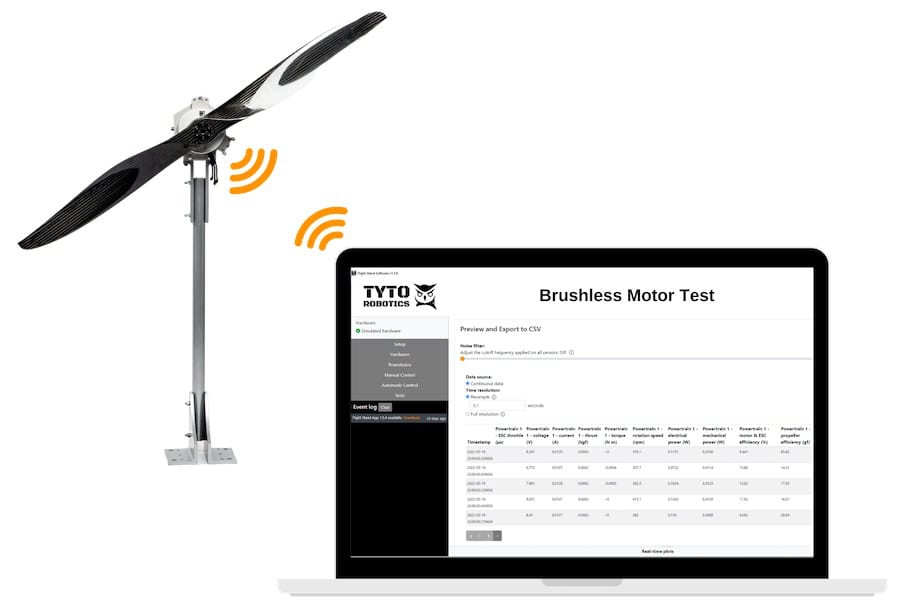
Tyto Robotics
Drone Thrust Stands for Motors, Propellers & Gas Engines, Wind Walls for Drone & Aircraft Wind Tunnel Testing

Gold Partner

DC Inc
Data Acquisition & Combustion Testing Solutions for ICE (Internal Combustion Engine)-Powered & Hybrid UAVs

Silver Partner

United Electronic Industries (UEI)
Embedded Controllers, Avionics Testing, HIL Simulation & Data Acquisition Systems for UAV/UAS Applications

Silver Partner

Dynautics Ltd
Marine Autopilots, Unmanned Surface Vehicle Communications, Power Management Modules & Marine Simulators & Software

Silver Partner
Showcase your capabilities
If you design, build or supply Simulation and Test Equipment, create a profile to showcase your capabilities on this page
Products


Simulation and Test Equipment for Drones & Unmanned Systems

Commercial drones and unmanned systems serve in high-stakes environments, logistics, infrastructure inspection, agriculture, emergency response, and industrial monitoring, where failure is not an option. Ensuring performance, safety, and compliance with aviation standards starts with dedicated test equipment tailored to each phase of development and deployment.
Test equipment is not a monolithic category. It spans simulation platforms, physical stress rigs, electromagnetic compatibility systems, diagnostics hardware, and sensor validation tools. Together, these technologies enable developers and OEMs to simulate, stress-test, and refine commercial unmanned vehicles at every production stage.
Simulation & Loop-Based Testing Platforms

Test Equipment & Software for Drones by Zephyr
Modern unmanned systems are largely software-defined systems. Test equipment in the form of software-in-the-loop (SIL) and hardware-in-the-loop (HIL) simulators has become a standard component in the engineering stack. These platforms enable iterative testing of autonomous navigation algorithms, power systems, and sensor fusion logic in real-time conditions.
SIL environments allow developers to validate embedded software in controlled digital simulations before any physical hardware is introduced. HIL test benches, by contrast, connect fundamental hardware components, such as flight controllers, ESCs, and IMUs, to a simulation engine, allowing developers to observe actual hardware responses to mission scenarios and operator commands.
Some advanced HIL systems also include human-in-the-loop interfaces and support for user interface testing, ensuring seamless interaction between onboard systems and ground control stations.
EMC & EMI Test Equipment
Commercial drones often operate near sensitive equipment or in congested RF environments. Electromagnetic compatibility (EMC) and electromagnetic interference (EMI) test equipment ensure that UAV subsystems do not emit or suffer from harmful interference.
Typical setups include:
- Shielded test enclosures and chambers
- Spectrum analyzers and field probes
- Pulse generators and transient immunity testers
These tools support compliance with aerospace standards and are essential for testing high-power systems like propulsion drives and power distribution networks. Integrated setups may include both conducted and radiated emission measurement systems, allowing developers to assess full-system behavior in realistic RF conditions.
Vibration, Structural, & Environmental Test Rigs
For drones expected to perform in rugged conditions, environmental durability is paramount. The test equipment designed to evaluate this includes:
- Vibration test platforms, capable of simulating conditions experienced during flight, launch, or transport
- Thermal cycling chambers that expose components to rapid temperature fluctuations
- Dust and salt fog chambers for ingress and corrosion resistance testing
- Pressure chambers and IP rating test setups to assess waterproofing and altitude simulation
These systems can be integrated into automated workflows and support high-throughput validation for structural components, batteries, and enclosures. Many of these rigs comply with MIL-STD-810G and other industry-specific durability standards.
Propulsion & Power System Test Equipment
Electric propulsion systems require purpose-built test benches that can safely and accurately assess motors, ESCs, and power distribution units under load. Propulsion test equipment typically includes:
- Dynamometers for thrust and torque measurement
- Power analyzers and oscilloscopes for waveform diagnostics
- Cooling systems to simulate operational airflow or thermal load
For hybrid or fuel-powered UAVs, generator load testing platforms are used to assess output stability and transient response. Battery endurance test equipment and energy storage simulation tools support validation of modern Li-ion, solid-state, and alternative energy systems under real-world mission profiles.
Electronics & Component Diagnostics Systems
From avionics to payload controllers, electronics are central to every commercial UAV. Electronics test equipment ensures reliability at the board and system level. Common technologies include:
- High-precision multimeters and oscilloscopes
- Automated test equipment (ATE) platforms
- Logic analyzers and black box testing systems

Marine AUV Simulator & USV Simulator by Dynautics
These platforms can be integrated during both design verification and end-of-line production testing phases. Coupled with electronics manufacturing services (EMS), they help manufacturers identify latent faults, optimize thermal profiles, and confirm interface integrity.
For embedded software validation, systems often include software-in-the-loop environments that support automated test script execution and fault injection capabilities.
Sensor & Navigation System Calibration Tools
Drones depend on accurate navigation and perception systems. Test equipment for sensors includes:
- Magnetometer and compass calibration stands
- IMU and barometer test rigs
- SLAM testing environments with controlled mapping targets
- Doppler velocity log and sonar system simulators
Advanced radar system testing benches and motion platforms allow developers to verify data accuracy, latency, and environmental responsiveness under simulated flight paths or movement patterns.
Navigation and sensor testing hardware often integrates with HIL systems, enabling synchronized validation of control systems and situational awareness algorithms.
Communication & Interface Testing Platforms
Communication reliability is central to commercial UAV success. Specialized test equipment for communication systems includes:
- RF chamber systems for signal integrity and range simulation
- SATCOM and cellular link emulators
- Bluetooth and Wi-Fi module testers
These platforms support testing under signal degradation, latency, and handoff scenarios. Communication encryption test equipment is also used to validate secure data channels, especially in regulated or mission-critical operations.
Modular & Integrated Test Platforms

Propeller Balancer for Precision UAV Motor Testing by Tyto Robotics
For OEMs and integrators, modular testing stations allow configurable setups to match specific drone platforms or mission profiles. These platforms typically support:
- Swappable fixture beds for different component sizes
- Multi-signal data logging systems
- Combined SIL/HIL integration with environmental stress enclosures
Such systems enable efficient validation across propulsion, avionics, energy storage, and sensor payloads in a single workflow. Remote diagnostics and test automation support are often included for lab efficiency and consistency.
Emerging Directions in Drone Test Equipment
As commercial drones evolve, so too does the equipment used to validate them. Some of the most advanced developments include:
- AI model testing frameworks integrated with vision system testbeds
- Autonomous navigation algorithm simulation systems
- Payload integration and quick-swap module test stations
- Robotics and actuator test beds for gimbals, delivery arms, and docking systems
Furthermore, portable testing platforms are gaining traction for field-deployable diagnostics, especially for long-range UAVs used in energy, mining, and maritime operations. These systems allow real-time assessment of propulsion efficiency, signal integrity, and sensor calibration in remote environments.
Critical Testing for Commercial Drone Systems
Test equipment for commercial drones and autonomous systems is the critical infrastructure that enables safe, efficient, and compliant unmanned development. From modular simulation environments and EMC labs to sensor calibration systems and propulsion test rigs, this category encompasses all tools necessary for full-system validation.
As drone platforms continue to expand into new applications and environments, the importance of flexible, scalable, and precise testing solutions grows. The technologies featured here support engineering teams, manufacturers, and mission planners in building systems that perform as intended—reliably, safely, and repeatedly.


