

Aurora Flight Sciences, a Boeing company, has established a structured autonomy development and validation environment known as Accelerated Testing of Live Autonomy Software (ATLAS).
This test infrastructure is designed to efficiently transition software from initial development stages to fully integrated mission capabilities onboard aircraft.
ATLAS supports a stepwise advancement from simulation to real-world validation through a series of increasingly complex test phases. The process begins with software-in-the-loop (SIL) testing, where code is executed in a simulated environment capable of replicating multiple aircraft simultaneously. This supports rapid iteration and validation in early development.
Processor-in-the-loop (PIL) testing follows, using hardware that mirrors the vehicle management system (VMS) and mission management system (MMS). These setups are built for easy relocation between simulation labs, allowing autonomy to be validated on representative flight hardware. Hardware-in-the-loop (HIL) testing then integrates physical systems including sensors, actuators, and communication components to verify successful autonomy integration before any flight occurs. Aurora conducts HILSim across platforms ranging from small unmanned aircraft systems (UAS) to the DA42-based Centaur.
Frequent, typically monthly, flight testing is a key element of the ATLAS methodology. These tests begin with low-cost, low-risk platforms to reduce development risk while increasing mission complexity and system robustness. One Group 1 UAS used by Aurora weighs 13 pounds, is constructed from dense foam, and is capable of vertical takeoff and landing followed by fixed-wing forward flight. This hybrid design enables flexibility in testing within a compact airframe.

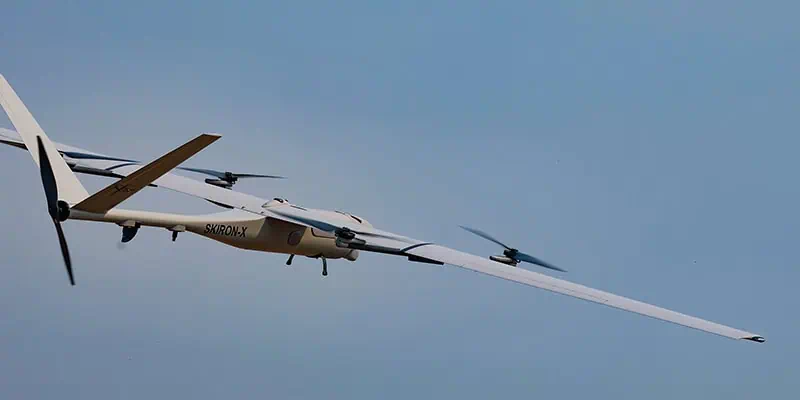
Advanced testing shifts to more capable aircraft designed to accommodate and evaluate new autonomous functions in operationally realistic conditions. The SKIRON-X platform, a Group 2 UAS, includes integrated electro-optical/infrared (EO/IR) gimbals, long-range communications, and modular interfaces to support customized payload integration.
Centaur, based on a certified twin-engine general aviation aircraft, provides Aurora with the ability to test autonomy as a surrogate uncrewed system. It is operated from a ground control station with an onboard safety pilot, enabling flight testing within the National Airspace System (NAS) while maintaining regulatory compliance.
Aurora has used ATLAS to develop vehicle teaming autonomy for missions involving detection, identification, location, and reporting (DILR). The system supports test environments composed of both physical and virtual assets, reducing cost while maintaining test effectiveness. For example, a Group 1 UAS may be outfitted with a virtual sensor, while additional virtual and live aircraft are integrated into the same mission scenario. The operator interface remains consistent, making it indistinguishable which aircraft and sensors are real or simulated. This capability allows scalable test scenarios with minimal cost impact.
Nick LaBarbera, Program Manager at Aurora, commented, “With ATLAS, we can quickly edit tests and add and remove assets with lots of flexibility. Not only can we efficiently progress from simulation to real fight tests, but we can straddle the line between real and virtual, allowing us to create the just-right balance of test cost, risk, and relevancy.”
Aurora’s iterative and layered approach supports autonomy development that is robust, cost-efficient, and structured for smooth transition to mission-ready systems.