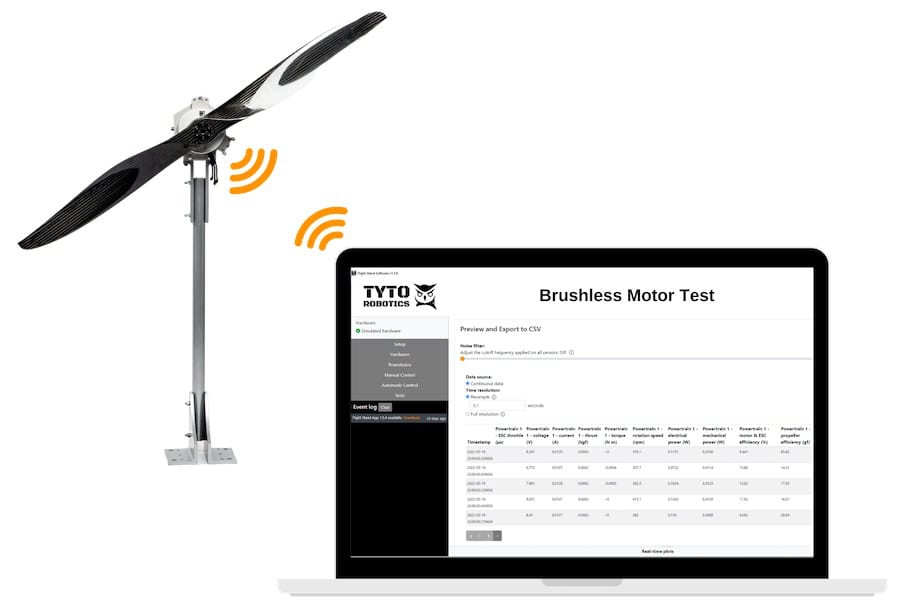
Tyto Robotics emphasizes the importance of understanding propeller performance coefficients to optimize UAV efficiency and design selection.
Propeller performance coefficients are dimensionless metrics that allow engineers to compare propeller geometries and designs regardless of scale or rotation speed, providing a more comprehensive assessment than static efficiency alone. By analyzing these coefficients, developers can determine which propellers are aerodynamically suited to specific operating conditions, helping save time and resources during UAV development.
In this article, Tyto Robotics explores the key propeller performance coefficients and demonstrate how to measure them using the Input Transformations feature in the Flight Stand software. While certain coefficients have limitations, particularly when assessing hover conditions at zero forward velocity, they still offer valuable insights for VTOL and tilt-rotor drones during forward flight. Leveraging these coefficients enables engineers to make informed design decisions, ensuring optimal propeller performance across a range of operational scenarios.
Read How to Measure Propeller Performance Coefficients on the Tyto Robotics website.