Josh Elijah, BotBlox Founder
Josh Elijah, Founder of BotBlox, discusses the origins of the company and its mission to create ultra-compact, rugged Ethernet hardware for unmanned systems, exploring design challenges in miniaturization, network management, and ruggedization, as well as emerging trends like single-pair Ethernet and the growing role of wired networking in autonomy.
With deep expertise in compact, high-performance electronics, Elijah continues to work closely with customers to architect drone systems optimized for size, weight, and power. As BotBlox expands its manufacturing capabilities and explores new frontiers in compute and AI integration, he remains focused on advancing the hardware that underpins next-generation unmanned technologies.
What first motivated you to establish BotBlox, and was there a specific challenge in unmanned systems that convinced you there was a real need for ultra-compact, rugged networking hardware?
I was working on a farming robot that was using a bunch of visible and NIR cameras to detect weeds and then use a mechanical tool to remove them. The robot drove between two lines of crops, a 300mm gap for it to hold four cameras, a main processor, and the tool. This 300mm gap placed a limit on the size of the robot; turns out fitting four cameras, a Nvidia Jetson, a battery, motor drivers, and the weeding tool in such a tight space was incredibly difficult.
The hardest problem was wiring it all together; the cameras used ethernet and so we needed an ethernet switch to connect them all up. The only options were off-the-shelf ethernet switches or professional grade embedded switches. The pro-grade switches were expensive and too large, I just needed a tiny little switch! In the end I settled with a Netgear switch that I disassembled and hacked pieces of the PCB off to fit it into a 70 x 80mm mm space I had.

The first version of SwitchBlox
The switch didn’t last long, bulky connectors and a harsh operating environment meant it failed after a few days in the field. While the cameras, motor drivers, battery and Jetson board had been designed to be embedded, the switch had not. I realised I had to do something so I designed a really tiny five port ethernet switch; 45mm x 45mm with a wide input range.
It fit my needs well and I figured it might help others, so I hand-soldered 100 units and put them online. I was right, within a few months they all sold out, and the idea for compact embedded ethernet infrastructure was born!
BotBlox has become known for developing high-quality Ethernet switches and boards tailored for UAVs and robotics. How do these differ in philosophy and design from traditional COTS networking solutions?
I think it’s always been about a myopic focus on making it small, rugged and low power. When you’re dealing with an embedded mobile platform like a drone or robot, every gram, every inch, every watt; it matters. This feeds directly into the design philosophy of BotBlox products. It’s about squeezing everything out of the available space, weight and power profile we have.
This is quite unlike traditional COTS solutions that really don’t care for this. With COTS solutions it’s about minimising cost, maximizing manufacturing yield. Many of the techniques we use at BotBlox increase cost and often make manufacturing much harder; but the end products are unmatched in size, weight and power.
When developing products such as SwitchBlox, GigaBlox, and Puck Mini, what have been the biggest technical hurdles, and how have you approached issues like connectors, power, and ruggedization?
Solving these technical challenges is the key to achieving our edge in size, weight and power. Let’s first look at network management software and see some of the challenges in implementing this on something tiny.
Software Management without bulk – Do more with less
Modern ethernet networks come with a plethora of useful tools like VLANs. Why would you even need such things on a small drone? Let’s take a common use case with a VLAN. Let’s say your drone consists of an internal network, some cameras, some motor controllers and an embedded processor, connected with an external facing wireless radio link. You probably don’t want a remote user to be able to directly access the motor controllers; that’s a cyber-security nightmare. So you would use a VLAN to segregate the network into the internal and external facing sides; that’s a feature you could set up on the switch.
The problem is that achieving VLAN means you need some kind of smart device on the switch; this is normally a microprocessor running an operating system like linux. Microprocessors come with burdens like needing RAM, memory; and this takes up space and power. Even an extra 30-40mm matters! Then you need to ensure it’s rugged. Instead, we took an STM32 microcontroller and stripped down linux to it’s core, so we could squeeze a basic command line interface onto a 7mm x 7mm microcontroller with only 256 Kbytes of flash memory. This harkens back to the time of writing video games for SNES; it means optimising right down to memory management and variable typing. But what it means is that we can achieve switch management in form factors that have never been achieved.
Practical considerations – Power, heat, signal integrity and connectors
On power and thermal management; really a lot of this comes down to tight electro-mechanical integration. Building a chassis that also serves as a passive heatsink for the main heat-generating chips, while also providing EMI shielding. This isn’t so much R&D as it is just good design, though we often have to go through multiple iteration loops ofsimulation + manufacture and testing to arrive at shapes that optimise heat transfer without adding bulk!

The board layout of one of our tiny routers; we don’t waste a single millimeter.
Getting designs so tight, on devices that transfer high bandwidths of data presents unique signal integrity challenges. Our aim is to not waste a single millimeter of board area, but that often means data integrity issues. Getting this working involves multiple iterations of a board before it works well.
Connectors are another big topic. Traditional RJ-45 connectors are dead for embedded ethernet, too big and not vibration tolerant. We increasingly use stacking connectors and format our routers as modules; allowing customers to integrate directly into their systems. We give them a ethernet router as a module that contains all the hardware, firmware and software necessary to build advanced writed networks, allowing them to focus on solving their application space.
Putting this all together and we create products like SwitchCore, an 8 port ethernet router in a 26mm x 26mm x 10mm module. Nothing this small has ever been achieved and it opens up advanced wired networking for next generation UAS systems.
The role of networking in unmanned systems is rapidly evolving. Over the next decade, how do you see Ethernet and emerging standards such as single pair ethernet shaping autonomy and data architectures?
We’re just at the beginning. The capabilities of unmanned systems continue to evolve and the demand for such systems to be enabled with more advanced capabilities (whether through AI, more sensor data, etc) is only growing. This calls for wired networking standards that can scale with the increasing data bandwidths on unmanned systems. Ethernet is poised to become the standard communication bus for embedded systems because of its robustness, ubiquity and ease of use. Put these two together and you end up with a compelling need for compact, rugged, low power wired networking. It’s all very well having advanced AI capabilities at the edge, but without the ability to move that data around, bottlenecks will eat into performance.

SwitchCore – One of our latest products, an 8 port 100BASE-T router module for UAS
Emerging standards like single pair ethernet present new ways to further reduce weight and size, specifically by reducing the number of wires from eight down to two. Given that wiring is often a huge weight burden on mobile vehicles, this 75% reduction has huge potential. Photonic switching and processing also presents a huge opportunity.
While photonics is mostly in its infancy and mostly targeted towards data center applications, the benefits of photonics such as hugely reduced power consumption (generic estimates place photonics as 10x less power hungry than electronic systems) and hugely increased data bandwidth (photonics can handle terabytes of data on a single fiber, whereas a single copper wire cannot easily exceed 100Gbps even with the most advanced modulation schemes).
This all being said, even just the move to ethernet for modern UAS represents a huge upgrade in data transfers; it shouldn’t be underestimated just how much even 1Gbps is for a UAS system, thus we’re still very much in a period of infancy where the current implementation is yet to catch up with the current advanced state of wired networking.
Where do you see BotBlox positioned within the broader unmanned systems ecosystem, and how do you balance responding to immediate customer needs with preparing for long-term industry shifts?
We already own the wired networking stack to a great extent. We are position to continue innovating in this space, by providing the components needed to interconnect systems from other players in this market together. You might even call us the glue that our customers use to connect UAS hardware together (Though I’m being a bit grandiose here!).

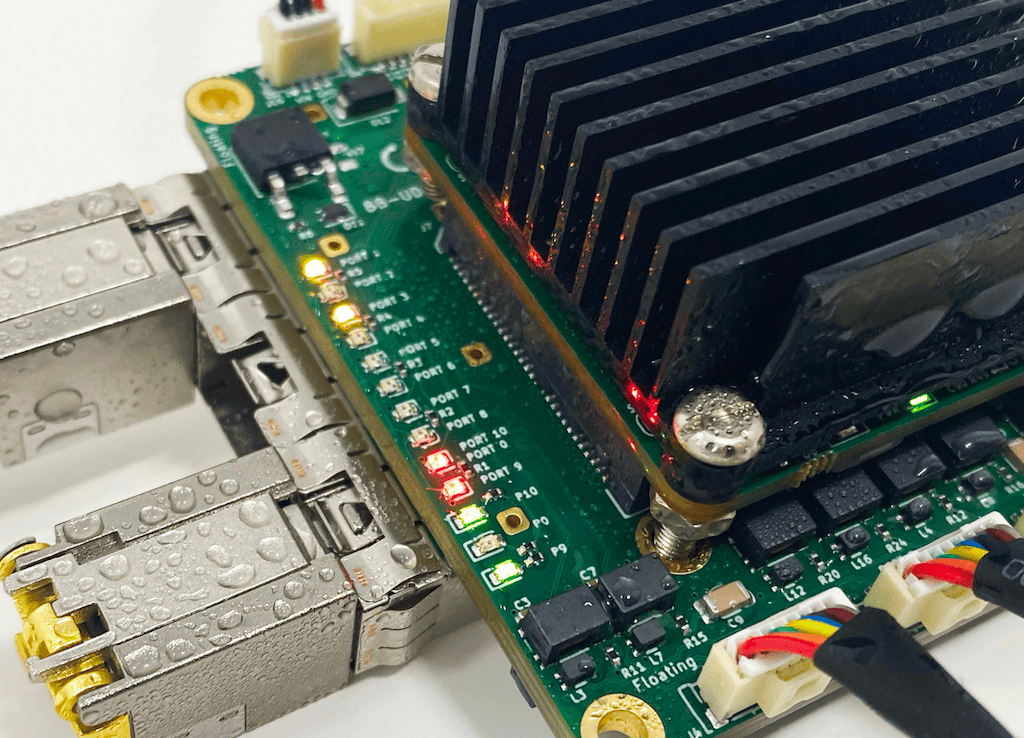
One of our latest products, Puck Edge, provides 8 x 1Gbps + 3 x 10Gbps in a 68mm x 58mm x 22mm, smaller than a credit card!
In a relatively simple vein we respond to immediate customer needs continuing to shrink our hardware while increasing data bandwidths to beyond 10Gbps (just keep doing what we’ve been doing). What’s critical is that we do this while maintaining secure quality assurance and supply chains. We’ve already initiated the setup of a modest manufacturing facility in the USA which will help us hit demand for USA made hardware while improving our own supply chain somewhat.
In addition to that, other opportunities for us are to start solving the compute side; our systems are ethernet routers and so naturally form a central point of a UAS system in which all data flows into and out of. This presents a unique opportunity to add further capabilities to our systems like compute and AI. Doing so in a scalable way, however, requires careful attention to customer’s needs.
Looking back, what have been the most surprising lessons for you personally in taking BotBlox from a side project to a commercial enterprise competing with much larger players?
The speed of evolution in this space has been shocking. Within 3 years (basically since the start of the Russia-Ukraine war), drones have gone from being a curiosity to being every government’s foremost military focus (both building UAS and CUAS systems). I certainly couldn’t have predicted the insatiable need and there is still a huge lack of good hardware in this space!
It’s also been surprising, and reassuring, to see how product quality trumps everything else. In our earlier days we really were a ragtag operation based from a garage in the UK midlands and yet that wasn’t stopping some of the largest US primes from purchasing our hardware. I remember distinctly an order for a certain US prime that I won’t name, it was a shipment of 50 tiny ethernet switches. They wanted to arrange pickup from our house, so we agreed, thinking they’d send a small van. Instead they sent a 20 tonne military flatbed truck into our housing estate to pick up a 3kg DHL box. The truck couldn’t even fit into our road. This was eye-opening (and hilarious) for me!
Finally, the ability to iterate on new products quickly really is the key to success in this space. I can lead a product from ideation to golden samples within about 3-4 months, and I can have an idea of commercial viability within 6-8 months. That minimises time spent on long development cycles and gives us the freedom to try lots of different ideas.
How do you maintain innovation and a strong engineering culture within a small, highly technical team while also managing the broader responsibilities of being a founder?
I think it’s crucial to communicate “Commander’s Intent”, rather than just command. Explain to your team the reasoning behind what you want, rather than just what you want. When a team understands the “why” they make better decisions and need less hand holding.
It’s crucial to have a myopic focus on the customer’s need, and the product we build to solve that need, rather than what you think they need. Staying in sync with what’s actually required rather than getting diverted by expensive engineering projects is crucial to building the best systems and staying profitable.
As a founder of what is now a rapidly scaling company, I don’t usually get to work on the deep design engineering anymore. Most of my time was spent in product architecture, product management, keeping teams in sync, and customer needs. While I miss the days I could spend weeks on end in a PCB design, I realise my responsibility is first and foremost to ensure our products solve the growing needs of modern UAS, and if that means delegating, then that’s what I have to do.
As you look ahead, what excites you most about the next phase of BotBlox’s journey, both in terms of technology development and your own role as a founder?
In terms of product strategy, compute and AI side is deeply exciting. We have a unique opportunity to expand our systems into this, since many customers already rely on us for the wired networking; these are the same customers who are crying out compact, rugged, stackable compute modules.
In terms of my role as a founder, I’m also deeply excited about building up western manufacturing and opening our first manufacturing facility. It’s always been my dream to manufacture my own boards, I finally get the chance to do that with BotBlox!