Suppliers
Add your company
Trakka Systems
Multi-Sensor Imaging Gimbals, Searchlights and VMS Software for Air, Land & Maritime Platforms

Platinum Partner


Kongsberg Geospatial
Geospatial Software for Real-Time Mapping, Data Visualization & Situational Awareness

Gold Partner

Packet Digital
High-Performance Drone Batteries, Power Management Systems, Fleet Management Software, Solar MPPT Integration, Celular C2 & Payload Communications

Silver Partner


Black Swift Technologies
Autonomous UAS, Research & Inspection UAVs for Industrial Inspection, Survey & Mapping

Silver Partner
Showcase your capabilities
If you design, build or supply Drone Flight Planning Software, create a profile to showcase your capabilities on this page
Products
Drone Flight Planning Software

Introduction to Drone Flight Planning Software
Drone flight planning software is the mission design and execution layer that translates operational objectives into structured, executable flight paths for Unmanned Aircraft Vehicles (UAVs). It serves as the interface between mission intent and autopilot logic, defining how an aircraft navigates airspace, interacts with terrain, coordinates sensors, and complies with regulatory constraints.

TrakkaMaps, a mission mapping & video management software for GCS, from Trakka Systems
In professional unmanned systems, flight planning software is a mission assurance component. Whether supporting tactical ISR, offshore inspection, or BVLOS corridor operations, the software must ensure predictable aircraft behavior, airspace compliance, sensor optimization, and safe integration with other airspace users. It provides the structured logic that allows unmanned platforms to operate reliably in complex, dynamic environments.
Core Functions of UAV Flight Planning Software
Professional UAV flight planning software converts geographic intent into deterministic flight behavior through several technical layers. While it works in tandem with flight control software to maintain the stability of the platform, its primary focus is on the spatial and temporal parameters of the mission.
Mission Planning and Route Generation
At its foundation, flight planning involves waypoint-based design, where operators define discrete coordinates that the aircraft follows sequentially. Each waypoint includes specific parameters such as speed, heading, and payload trigger events.
For survey and mapping, the software generates area coverage patterns like grid or lawnmower paths to ensure uniform data collection. Terrain-following capabilities allow the system to reference digital elevation models and adjust altitude dynamically to maintain a consistent ground clearance or sensor standoff distance. Dedicated mission planning software is often utilized to automate these complex routes, particularly for intelligence and surveillance roles.
Airspace Awareness and Geospatial Integration
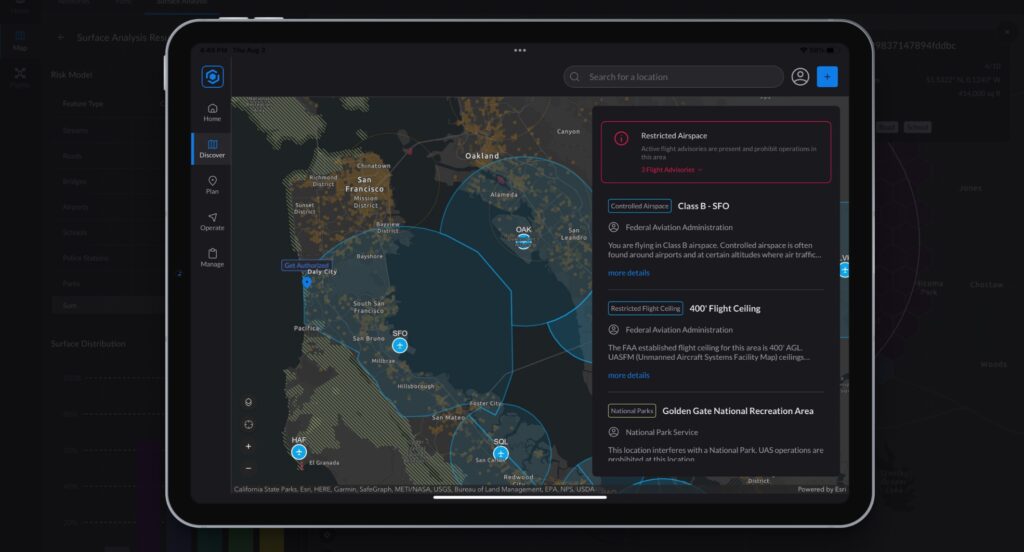
Flight planning suites typically incorporate aviation data layers. Integration with aeronautical charts and controlled airspace databases allows operators to design compliant missions. While drone compliance software is responsible for the actual regulatory rule-checking and audit trails, flight planning tools allow operators to visualize these constraints during the design phase.
Payload and Sensor Configuration

Botlink Capture, a drone flight planning and control app, from Packet Digital
Effective flight planning software for drones integrates payload configuration into the mission design. This includes defining EO/IR camera trigger intervals and gimbal angles. The software calculates ground sampling distance based on altitude and optics to ensure imagery meets resolution requirements. For LiDAR missions, the system manages flight speed and scan angles to maintain accurate swath width.
Real-Time Mission Re-Tasking
Operational environments are rarely static, and drone flight path software often supports in-flight modification of objectives. This includes dynamic waypoint adjustment and adaptive mission logic, such as initiating an orbit mode upon object detection or switching to contingency routes during a lost link scenario.
Multi-UAV and Swarm Coordination
As operations scale, drone flight plan management is moving beyond single-platform control. While high-level drone fleet management platforms oversee the health and logistics of an entire inventory, flight planning software handles the tactical deconfliction of multiple assets within the same airspace.
Applications of Flight Planning Software for Drones & UAVs
Military and Defense Applications
In military contexts, flight planning underpins ISR mission preparation. Route design accounts for threat envelopes, terrain masking, and communication relay requirements. Integration with broader flight control systems ensures that the aircraft can execute these tactical maneuvers with precision in contested environments.
Commercial and Industrial Applications
Infrastructure inspection relies on drone route planning software to ensure repeatable missions for asset comparison over time. Surveying and mapping operations depend on automated grid patterns and overlap calculations to produce high-quality 3D reconstructions. In energy and offshore sectors, the software accounts for wind, magnetic interference, and complex metallic structures.
Emergency Services and Public Safety
Disaster response missions require rapid area assessment. Drone flight planning enables the quick generation of search and rescue grid patterns, reducing human error and increasing the probability of detection in dynamic scenarios like wildfires or structural collapses.
Architecture & Integration Considerations
The integration of a drone flight planner depends on the hardware and software ecosystem of the system, particularly its relationship with the GCS software used at the ground station.
- Ground Control Station Integration: Flight planning software must link with map rendering engines and telemetry displays to ensure uploaded plans translate into autopilot-executable commands.
- Cloud-Based vs. On-Premise Architectures: Cloud systems offer centralized fleet coordination, while on-premise architectures provide the data sovereignty required for defense or critical infrastructure.
- Integration with Autopilots: The software must interface with flight control stacks like PX4 and ArduPilot using standardized protocols such as MAVLink.
- Remote ID and UTM Integration: Connectivity with Remote ID frameworks ensures regulatory compliance and enables digital flight authorization for BVLOS operations.
Emerging Capabilities in Drone Flight Planning
The development of UAS flight planning is trending toward higher levels of autonomy and integration:
- Fully Autonomous Mission Orchestration: High-level objectives are translated into adaptive flight behaviors with minimal operator intervention.
- AI-Driven Route Optimization: Artificial intelligence is used to optimize paths for energy efficiency and risk minimization.
- BVLOS and Detect-and-Avoid Integration: Onboard DAA systems enable dynamic route modification in response to non-cooperative aircraft, which is fundamental to scalable long-range operations.
- Autonomous Docking Station Integration: Planning software now incorporates launch, recovery, and recharge cycles for persistent operations.