


Suppliers
Add your company
Nokia
Nokia Drone Networks: Fully Automated Drone-In-A-Box Solution for Industrial Operations

Platinum Partner

Austars Model
Advanced VTOL & Fixed-Wing UAVs | State-Of-The-Art Technologies for Unmanned & Autonomous Aircraft

Platinum Partner

Beyond Vision
Fully Autonomous Multirotor Drones & Hybrid VTOL UAVs With AI Capabilities

Platinum Partner

TEKEVER
Fixed-Wing UAV Systems: Modular VTOL, Long-Range Maritime UAV, Tactical ISR UAS

Platinum Partner

Ascent AeroSystems
Compact, American-Made, All-Weather Drones Designed To Fly When Others Can’t, No Matter The Mission

Platinum Partner

Volatus Aerospace
Drone Technology Supplier & Drone Service Provider for Public Safety, Transportation & Training

Platinum Partner

BlueBird Aero Systems
Tactical Hybrid VTOL UAS & Loitering Systems for Multi-Domain Operations

Gold Partner

Hydronalix
Advanced Man-Portable USV Platforms for Defense, Tactical & Government Missions

Gold Partner

Tamilan
Quadcopter Airframes and Complete Drone Solutions for Civilian, Commercial, and Military Applications

Gold Partner
Altus LSA
Innovative Turnkey UAS Solutions for Mission-Critical Civilian & Defense Applications

Gold Partner

DPI UAV Systems
Revolutionary Tethered Unmanned Aerial Systems for Tactical, Commercial & Industrial Applications

Gold Partner

Vantage Robotics
State-Of-The-Art NDAA-Compliant Drones & Ground Control Stations for Mission-Critical Operations

Gold Partner

Inspired Flight
Professional, US-Made Multirotor Drones for Commercial & Government Applications

Gold Partner

Edge Autonomy
Long-Endurance Fixed-Wing & Hybrid VTOL UAVs | UAV Payload Camera Systems | Power Systems

Gold Partner

Xer Technologies
Heavy-Duty, Heavy Payload Drones for Industrial Inspections, Public Safety and Search & Rescue

Gold Partner

Cannon Dynamics
Customizable, Long-Range Fixed-Wing Drones - Twin-Wing Design Heavy Lifting Drones

Gold Partner


Roze Mobility
Long-Endurance & Heavy-Lift Autonomous Helicopter UAS Platform for Civilian & Military Applications

Silver Partner

BraveX
Versatile Fixed-Wing & VTOL Unmanned Aerial Vehicles (UAVs) for Long-Range Civilian, Commercial & Military Applications

Silver Partner

Phoenix Flight Industries
Innovative Hydrogen-Powered UAV Systems & Hydrogen Refueling Services

Silver Partner

Nearthlab
AI-Powered Autonomous Drone Solutions for Public Safety, Defense, and Industrial Inspection

Silver Partner

Arctic Horizons
Cutting-Edge Unmanned Aerial Systems & Counter-Drone Technologies for Government & Defense Applications

Silver Partner


Alpha Unmanned Systems
Helicopter UAVs: Rotary Wing Drones for Maritime, Naval & Security Operations | UAS GCS

Silver Partner

T-DRONES
Industrial Multirotor Drones, Long-Endurance Fixed Wing VTOL UAVs, & High-Energy-Density Li-ion Batteries

Silver Partner

Performance Drone Works (PDW)
High-Performance Autonomous Drones for Mission-Critical Civilian & Military Applications

Silver Partner

WISPR Systems
Customizable, Industrial Quadcopter Drone for Aerial Mapping, Surveying & Inspections

Silver Partner

CHC Navigation
GNSS Positioning & Navigation Systems, Mobile Mapping UAV LiDAR & Unmanned Surface Vehicles

Silver Partner

Acecore Technologies
Professional Drones, Quadcopters, Multirotors & Hexacopters for Cinematography, Survey & Inspection

Silver Partner
Showcase your capabilities
If you design, build or supply Public Safety Drones, create a profile to showcase your capabilities on this page
Products


Public Safety Drones

Introduction to Public Safety Drones
Public safety drones and Unmanned Aerial Systems (UAS) are high-reliability, semi-autonomous aerial platforms engineered to support life-critical missions for emergency services. These systems are defined by ruggedized airframes, secure data architectures, and specialized sensor suites designed for integration into complex, regulated emergency response environments. Public safety UAS serve as rapidly deployable aerial sensor nodes, providing high-fidelity intelligence in scenarios where ground-based assessment is restricted by time, geography, or risk.
Core Applications of Public Safety Drone Solutions
Law Enforcement
Agencies utilize law enforcement drones primarily for tactical situational awareness. Whether managing high-risk warrant executions or tracking suspects, drones provide commanders with a persistent aerial view, reducing officer exposure.
A critical field is public safety drone detection and passive counter-UAS (C-UAS) awareness. While law enforcement units are typically restricted from active mitigation, they often deploy passive detection sensors integrated into perimeter security drones to monitor unauthorized drone activity near critical infrastructure or large-scale public events. Technical priorities include low-latency AES-256 encrypted video, precise geolocation metadata, and forensic-grade data handling.
Firefighting and Fire Rescue

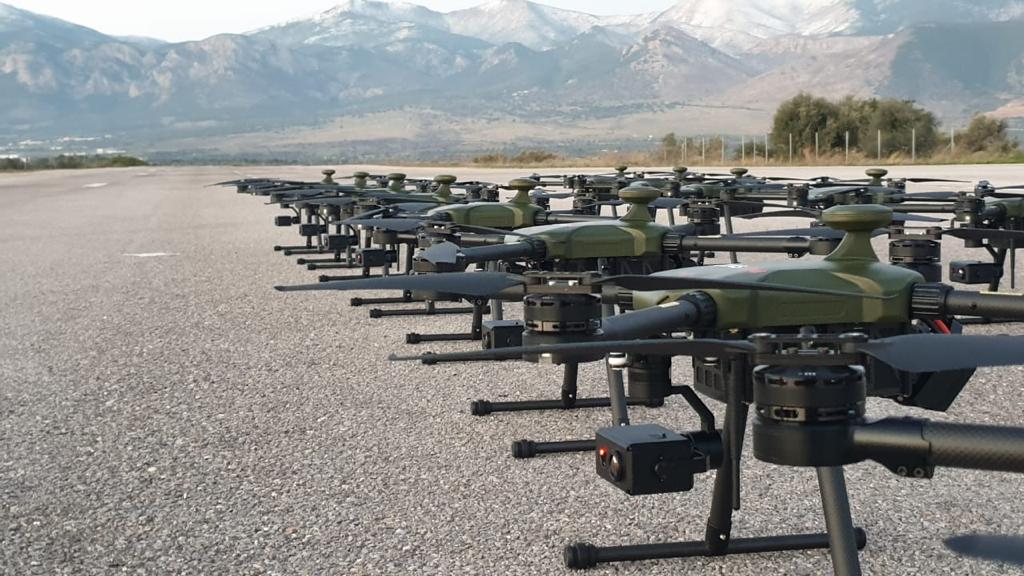
BVH616 (HEIFU Pro) Public Safety Drone by Beyond Vision
In the fire service, firefighting drones analyze thermal signatures and structural integrity before personnel enter a hot zone. Thermal imaging payloads identify heat propagation through structures or dense vegetation that is invisible to the naked eye.
For wildland firefighting, long-endurance drone platforms track fire fronts and identify spot fires across vast acreages. Overwatch drones enhance safety by providing persistent monitoring of crews during hazardous material (HAZMAT) incidents or prolonged structural fires where collapse risks are high.
Search and Rescue
Modern search and rescue drones leverage AI-driven sensor fusion by overlaying electro-optical (EO) and infrared (IR) feeds to detect human signatures in thermally complex environments like forests, mountains, or debris fields. These systems act as force multipliers, covering vast search grids rapidly, particularly during night operations or in degraded weather conditions.
Disaster Management and Civil Protection
Following hurricanes, floods, or seismic events, public safety UAS provide rapid damage assessments. High-resolution mapping and LiDAR payloads enable authorities to evaluate infrastructure health and prioritize transport route clearance. Rapidly scaling coverage during the initial response phase is a primary driver for the adoption of integrated public safety drone services.
Components of Public Safety Drone Systems
Airframe Engineering and Platform Selection
The choice of airframe is dictated by mission parameters. Multirotor drones for public safety are preferred for urban environments and close-in inspections due to Vertical Take-Off and Landing (VTOL) capability and precise station-keeping. Conversely, fixed-wing UAS and hybrid VTOL systems are selected for wide-area disaster monitoring or long-range search and rescue where aerodynamic efficiency is paramount. Hybrid platforms offer significant flight time advantages for large-scale operations.
Propulsion, Power, and Operational Endurance

AR5 Fixed-Wing Public Safety UAS by TEKEVER
Drone battery technology remains a primary constraint on mission duration. Professional systems utilize hot-swap battery designs, allowing for continuous operations during extended incidents without powering down the flight controller or losing the data link.
Resilient Communications: FirstNet and ESN Integration
Reliable data links are the backbone of public safety operations. While many systems rely on encrypted Line-of-Sight (LOS) links, there is a shift toward Beyond Visual Line of Sight (BVLOS) operations supported by LTE technology and 5G connectivity. Integration with dedicated public safety broadband, specifically FirstNet or the Emergency Services Network (ESN), ensures that drone telemetry and video streams receive priority and preemption on the network.
Key Sensors & Specialized Payloads
The operational efficacy of a public safety UAS is determined by its sensor architecture. Modern units typically integrate multiple imaging and detection modalities into a single stabilized gimbal to provide unified situational awareness.
- Electro-Optical (EO) Sensors: High-resolution cameras with 4K+ imaging and significant optical zoom capabilities for long-range identification and evidentiary documentation.
- Radiometric Thermal (IR) Sensors: Long-wave infrared (LWIR) bolometers used to detect heat signatures in search and rescue or identify structural hotspots in firefighting.
- Laser Rangefinders (LRF): Precision modules that provide instantaneous GPS coordinates and distance measurements for targets located up to several kilometers away.
- CBRNE Detection: Specialized sensors for mapping chemical plumes, gas leaks (CO, H2S, etc.), and radiation levels without exposing personnel to hazardous environments.
- LiDAR and Photogrammetry: Laser scanning and high-accuracy mapping payloads used to generate survey-grade 3D point clouds for scene reconstruction and damage assessment.
- Acoustic and Tactical Payloads: Integrated hardware including high-decibel loudspeakers for victim communication and searchlights for low-light operations.
These sensors function as integrated nodes within the aircraft’s data stream, enabling real-time analytics such as automated person detection and temperature threshold alerts.
Secure Video Transmission for Public Safety Drones
For law enforcement and government agencies, data security is vital. Secure drone video streaming software manages end-to-end encryption and authenticated handshakes. Because drone-derived data is often evidentiary, drones used for public safety must support a rigorous chain of custody, including tamper-evident logging and secure cloud storage that integrates with Digital Evidence Management Systems (DEMS).
Emerging Trends in Public Safety UAS
Public safety UAS manufacturers are moving toward increased autonomy and the deployment of automated docking stations, often referred to as drone-in-a-box solutions. These systems enable remote deployment and persistent monitoring without requiring a pilot to be physically present at the launch site.
Advancements in Detect and Avoid (DAA) architectures are facilitating the expansion of BVLOS operations, allowing emergency services to provide regional-scale coverage. Furthermore, the integration of public safety UAV data into digital twin platforms and smart city infrastructure is enabling real-time urban management and enhanced resilience during large-scale emergencies.


